11 August 2006

on nature

i finished making a mini comic. really just a compilation of sketchbook stuff from the past 2 years. and i gave one to john maeda since i was delivering some over to PLW anyway. in exchange, he gave me a copy of his latest book/exhibit -- "nature"

it's always interesting to see what people choose as beautiful or simple or evocative... all of those things. i was struck by the moth on the asphalt. i found a similar thing when i was in pennsylvania, except it was a spider trying to kill a butterfly. i chased the spider off and saved the butterfly('s now dead body). butterflies and moths fascinate me. especially when i see close-up pictures of them. the scales. the proboscis. they're so delicate. the scene from pennsylvania also stuck with me because it was a simple reminder that nature is impermanent and not as "nice" as we'd like to think -- things die; things are killed; things bleed; things hurt; things in nature exist because there's no option not to. only humans seem to try to live outside of this.

i guess at this point i could make some comment about sartre's statement that we brought about our own existence. or maybe something about vegetarianism. or something else philosophical. but i think i'll just leave it at existence. past and future don't matter; there is only now and what must be done.

Time and Space died yesterday. We already live in the absolute, because we have created eternal, omnipresent speed. -- from the futurist manifesto


\\---------------------------------!------------------------------//

(Quotes from the books in grey. The Q: parts are the interviewer. A: is John Maeda. Hopefully he'll forgive my copious usage of his book to further my own discourse)

Q: When you are using the mouse to draw, do you have a clear idea of what the result will be on the screen?
A: At least 90% of the time I can predict what's going to happen. It's the 10% of the time that gets me excited. It's the same way when you're working with any material. You can draw a perfect picture of a person, but nobody will care about it. But if you draw a perfect picture of a person on some kind of oddly constructed material, something happens. Something bad happens. But that bad, for those who are creatively trained can be really good. It doesn't happen all the time but when it does it is a moment that should be appreciated, (p.16).

I can definitely vouch for this sentiment from my own creative standpoint. I mean... part of the reason I think that people are unimpressed with realistic images any more is because of the prominence of photography in our every day lives. More and more, I value the "mistakes" that happen in my work.

Q: Do you think it's more difficult for someone who's been trained as a computer engineer to start to think intuitively? Or do you find it more difficult to help the person who is artistically trained to think technically?
A: That's the perfect question, and it's something that I often think about. The answer is that it is much harder to get someone who is technically trained to move over to the artistic side. I'm not sure why. I think it's because the thinking space of a technologist tens to be narrow and focused -- this makes it hard for them to accept that waht might be "wrong" is sometimes right. The artist's mind is always open and diverging -- on the other hand this makes it hard for them to enter the constrained space of programmatic thinking. At times it can be suffocating, (p.16).

Oh man. Definitely a question I often ponder. I mean. I guess I feel strange coming at this from the standpoint of someone who considers herself both an artist and an engineer. But sometimes I think that mechanical engineering -- at least when it comes to mechanical design -- isn't so different from art. Mechanical design feels very intuitive. At some point, you need the equations to chek out your design to make sure it's ok, but the beginning... it's intuition. And this is one reason I think that designers get better with age. Intuition builds off of experience. And the 10% "accidents" still happen in the mechanical world.

Q: Many contemporary art movements have emphasized the importance of the artist's intention or idea over the technical mastery of materials. It may seem surprising but the computer is so complex to use as a medium that it seems to demand a return to the fundamentals of technical mastery or craftsmanship. How important is craftsmanship in your own work?
A: this is a really great question because I've changed my position so many times on this over the last decade. The fact that I make my own art is important to me. This approach, I realize, is not so popular today.
However, the general public, if you care about them, still thinks that artists make things. For example, they'll go to see Christo's Gates in New York City. The average person thinks there's this guy named Christo who put these gates together one by one, painted them orange and put them all over New York. When the average person realizes the artist had this amazing concept but did not actually build the piece with his or her own hands, they may get kind of confused.
Q: Or disappointed.
A: Or disappointed. A more sophisticated person can understand that the actual making of art may not be nearly as important as what the art actually represents. However, I've discovered that I'm very interested in the 95% of the population that may be disappointed.
In the field of technology-related art, there are very few who have both technical mastery of the computer and creative ideas. There are those who have just the ideas without the skills to make, who use massive bands of technologists as their construction team. this is today's dominant production model. It does not differ from making a Hollywood film in some senses. I wish to be thought of as more of a personal preference, (p.19).

Based on how much of my art has changed from the 10% of "mistakes" I've made, I think there is validity to the idea that should be artists who have a hands-on relationship to their medium. In some respects, if you're working in concepts, you're only limited by your brain... your conceptual model. But you might not understand why such concepts might never come
into being. To contrast, though, if you work in concepts, you might be the one who pushes some new technology to be further developed to help realize your concept. I guess it's two sides of the same coin, in some sense. You have a concept, and when you try to realize it, you might run into problems. Sometimes these problems change your concept. Other times, you figure out a way to conform the materials to your vision. I think one positive aspect of actually working with materials is the ability to explore the limits of the materials yourself. There's a lot of knowledge to be found through physical interaction. I think the trick is knowing when to be conceptual and when to be intuitive about your process. Sometimes the materials "know" more than you do.

Q: You often emphasize the importance of developing a deeper and more human relationship with the computer. Can you explain what you mean by this? As an artist is your relationship to the computer less human or humane than the relationship of a painter to his brushes or paints and canvas?
A: I was visiting one of my mentors in Japan when his friend, a traditional landscape painter in the Japanese style, dropped by his studio. The visitor smelled like paint and he had all of the attributes of someone who has been touched by his medium in a way that carries a kind of romanticism. What I lament is that my work with the computer has left me nothing but scars inside my hand tissue that are entirely invisible. I'm not saying I want a pixel-inflicted scar on my face, but sometimes I feel that the way I realize my digital artwork could be seen in the same way as a person that creates Excel spreadsheets. What differentiates a digital artist from a conventional office worker? (p.20).

Good question. Again, something I've been pondering. And I think I came to my conclusion that my own interests lie in the physical interfaces to the computer. Maybe it's my training as a mechanical engineer. Maybe it's my love for pens and pencils and paper. I don't know. But I have a special fondness for the physical interaction. I guess that maybe it's that I like the tactile knowledge... I like intuition. And in some ways, I don't feel the same intuition about the art I create on a computer. Except with OPENSTUDIO. And then, it's more of a fondness for the simplicity and the fact that the digital tools don't cover up the physical flaws. I've ended up with a lot of mistakes on OS, and I find that I like a lot of them. Maybe in some way, I feel that OS allows for that 10% to happen. And because the interface doesn't allow for perfectionistic tweaking, I tend to leave them.

Maybe there is a romanticism attached to materials. I think this is partially due to the history of the materials. The smells, the feeling of using them, the sounds of using them... they all evoke a rich and diverse past. The computer doesn't have this past yet.

The past is something that is evoked. Objects don't carry the past with them, they simply evoke what you know about its past... you fill in the blanks. Maybe if there were a rich history of computer art, things would be different. But mostly for me, computers evoke MS Paint and photoshop and childhood when computers were still so new. And work. Computers evoke work. But the same can be said for the fact that pens evoke the feeling of taking notes in class and writing the numbers 1-100 because my teachers said I had to.

I don't know. Just some thoughts.

17 July 2006

information, the internet, the public, and nostalgia

A public space is public when it either maintains the public order or changes it, (Vito Acconci).

The public gathers in two kinds of spaces. The first is a space that is public, a place where the public gathers because it has a right to the place; the second is a place that is made public, a place where the public gathers precisely because it doesn’t have the right – a place made public by force, (Vito Acconci).

Although Acconci was talking about space -- parks, streets, buildings, etc. -- I feel that these ideas also apply to public vs. private information, to the concept of internet, to creative commons vs. copyright. Virtual space. Not to sound like a digital utopian/net-o-phile/whatever, but it's true that the internet has changed the way we think about some fundamental concepts, and I feel that when viewing the internet as a public space through the lens of Acconci, it's possible to see how it falls into the two categories.

I guess that maybe I'm not the person who knows best about this. All I know is the stuff that has gotten hashed out in two semesters of CMS classes (thanks, Henry :) ), but it's something I think about, and is something I care about, so maybe I can still have something to say in the matter even though it's not really my area of study.

The internet. In some ways, I can barely remember the time I didn't have it. But even though the memory is vague, I remember the first webpage I made -- in fact, it was the first thing that came up when you searched for my name for a long time. I remember when I used to get games via BBSs. I remember shareware and Duke Nukem and Crystal Caves and Commander Keen. I remember my first computer -- an Atari. And, in some ways, I realize my generation's role as the first people to have pretty much grown up with computers. I used to be fascinated by the screeching sounds of the modem communicating to another computer. So horrible, yet so wonderful at the same time. In some ways, it's still the sound of the future for me. I remember some of the first CD drives for PCs. I remember building my first computer. I still use my AOL screen name from 6th/7th grade. I've been around computers so long, that I take them for granted, take the knowledge of how to use them as something everyone knows. Well.. at least all my friends know. So I'm always surprised when my step-mom or my mom or my dad don't know about things. I introduced my dad to flickr. He's decided to get a paid account now. I find this really amusing.

But back to information. Transfer of information. That's what the internet is good for. I can find people who have my same interests all over the world. I can buy toys from my childhood (thanks to ebay). All of this and more has led to the growth of the long tail economic model. Lots has been said about this, and I don't know that I can really say any more interesting things than have already been said. So back to Acconci. "The public gathers because it has a right to the place." Take away this right, and you take something unique about the internet away.

I get really frustrated reading about the whole net neutrality debate. Particularly from the standpoint that our politicians are so distanced from society/technology, that they really seem to have no clue. Or at least most of them seem this way. Jon Stewart has definitely made fun of this one a lot. But, seriously, I listen to them talk and it's obvious that they don't really know things. And I also think that this whole concept of internet, of connectivity across the world, is just at its beginnings. So much that we don't know, so many uses left to be found -- uses that can only be made by people who use the internet. The uses of the street. The uses of the public.

The internet allows people to redefine public. It allows fan communities to form. It allows niche groups to have a say. In some ways, it has the potential to be a wonderful tool for democracy. The internet is very much a place for the public.

The internet is also a place where the public can reclaim things made private. Piracy, mp3s/file sharing, open source software, etc. These are all reclaimations of privatized information. The internet is a place where information can be "made public by force"... the force of numbers. The force of anonymity. The force of the public.

The space that is made public began as its own opposite, This was a space that was never meant to be public at all: a royal space, or a presidential space, or a corporate space. This private and privileged space had inherent in it, from its beginning, the seeds of public space: the fact of its existence provoked desire, its privacy functioned as a taunt to the public that felt left out. Once that space has been taken over by force and made public, it has inherent in it, in turn, the seeds of private place, the seeds of re-defined and re-inhabited privacy: the public that takes it over is working its way up to the royalty or the presidency or the corporate office. Private space becomes public when the public wants it; the public space becomes private when the public that has it won’t give it up, (Vito Acconci).

\\--------------------------------------------------------------//

In the space that is public, the public, whose space this is, has agreed to be a public, these are people “in the form of a city”, they are public when they act “in the name of the city”. They “own” the city only in quotes. The establishment of certain space in the city as “public” is are minder, a warning, that the rest of the city isn’t public. New York doesn’t belong to us, and neither does Paris, and neither does Des Moines, (Vito Acconci).

No one owns the internet. No one should own it. And I think there's a very interesting interplay of public vs. private on the internet. In some sense, it's a space that everyone has agreed is "public." But it's also a space where propriety of information -- privacy, of sorts -- comes into play. Hacking websites isn't "allowed." I mean... it can be done, but it's messing with someone's own "private" place. Even though everything about the webpage (the source and the styles and the images, etc) are all open for the public to see. Blogs. Blogs are some place I find the interplay of public and private most interesting. There are all these teenagers (I reserve the right to talk about them because I once was one of them) who post their most inner feelings for all to see. Often involving overly-done and melodramatic poetry. Possibly a black background on their journal. In some ways, by showing it to people who are numeros and anonymous, it's almost like privacy. At least, I never got worried about posting things in my journal until my friends found it. And then I would change journals, or make private entries, or something along those lines.

And, you know, to this day I still find this concept of anonymity to be important. Especially when it comes to showing my sketchbook. I would rather show my sketch book to a complete stranger than to my parents. Or my friends, usually. The distance is somehow soothing. Everything becomes more objective. And in some ways, it's just a different form of performing. I can only perform when I can't see the audience, when I don't have a connection to the audience.

\\------------------------------------------------------//

Public space, in an electronic age, is space on the run. Public space is not space in the city but the city itself. Not nodes but circulation routes; not buildings and plazas, but roads and bridges. Publicspace is leaving home, and giving up all the comforts of the cluster-places that substitute for the home. Space on the run is life on the loose. There’s not time to talk; there’s no need to talk, since you have all the information you need on the radio you carry with you. There’s no need for a person-to-person relationship, since you already have multiple relationships with the voices on your radio, with images of persons in store windows and on billboards; there’s no time to stop and have a relationship, which would be a denial of all those other bodies you’re side-by-side with on the street, one different body after another, one body replacing another. There’s no time and no need and no way to have “deep sex”: in a plague year, in a time of AIDS, bodies mix while dressed in condoms and armored with vaginal shields – the body takes its own housing with it wherever it goes, it doesn’t come out of its shell. The electronic age and the age of AIDS come intermixed in an age of virus, whether that virus is information or disease. Each person becomes too infected, either with information or with disease, to be with another. You come to visit, not to stay, (Vito Acconci).

I felt this last night when I didn't feel safe to stop anywhere to sit and eat a dinner.
Why does the concept of ownership feel so foreign to me?
A 30 minute drive away might have well been another country.

12 July 2006

thoughts on creation (in both engineering and art)

where do ideas come from? how do we link things together? how do we start the creative process? these questions intrigue me, push me to explore my own creative process and the process of others.

a while back, i met with arthur ganson and talked for a while, asked him lots of questions, tried to gain an understanding on how he went about doing things. one of the questions i asked: what was his design process? his answer: most of the time, he thinks about how it will move/speak for/to an audience. sometimes an item is a catalyst for the design (z.B. artichoke leave walking). sometimes the idea is more nebulous and what drives the design is the overall aesthetic presence of the piece (z.B. the cloud sculptures).

maybe sometimes it takes asking someone else a question to get yourself to ask the same question to... um... yourself. at least, until ganson gave me his answer, i never really thought about my own design process -- it just came about. but that's not a good answer for people. it really isn't an answer; it's just me not actively thinking through the process.

so i started thinking about my own experience with design -- both in engineering and art and the combination of the two. and i think i have a very similar manner of doing things. let's take comics/drawing/art as my first example (seeing as i actually have pictures of the work)

method 1) i have a clear idea of what story i want to tell. this is probably the majority ... like the comic i recently did about my travel woes. or jeoffrey. or various other stories of my day. example 1

method 2) i start with a line or a shape and use it to catalyze a drawing around. often this is an eye or a mouth or an expression i want to capture. example 2 and example 3

method 3) i have a certain way i want to lay out a page or maybe a certain method i want to use to do this. in other words, i want to achieve a certain effect. i don't really know what the content will be before i start; the method shapes the content. this is a harder example to find, and the only one i can think of is a photograph where i wanted to try to sign my name using car tail lights on a long exposure (around 10 seconds). example 4

a similar process goes on when making a wire sculpture or doing a more traditional engineering design. examples:

method 1) i need to make something that does this particular task. in general, 2.007 contest forces this method. other examples are like... making a mechanism that can sign your name.

method 2) i found a really cool part that i want to use, like the paperclip that started me on the path of making the wire robot guy with a sword. or maybe i want to use a particular mechanism because i think it'll be fun.

method 3) i want to build something that has a particular presence... a feeling. the dancing giraffe was a bit like this. but not quite as successful as i'd have wanted it to be.


anyway. these methods switch around during different phases of the design process -- every design is some combination of these. but these are the three clear ways i've found to start. even working today on things with a fellow media lab student, alea, we touched on these different methods with her different projects. she wants to make a mechanism to sign her name. clear goal-oriented start. she has some bits of glass she found that she wants to use in a stained glass/wire thing. more of a method 2. i gave her a bit of wire and told her to make something with it, and she made a bird. again, method 2.

i feel like methods 2 and 3 are more likely to be found when creating an art piece, and method 1 is more traditional engineering. but there's no reason why the other methods couldn't be used in traditional engineering. maybe more on the design side -- i.e. i want the end users to have this experience. or if your materials are limited, maybe there's a play between method 1 and 2, with i need to do this, but i have this.

hm. i don't know. just some thoughts.
anyone else have any thoughts?

10 July 2006

SNAP - the people version

Cast (the older ones):
Amelia - Glorianna's niece. From NYC. At the workshop for three of the five days.
Dimitri - Just finished his first year at UNO. From New Orleans. There for all five days.
Garrick - From New Orleans. Carol Bebelle's... nephew? There on Wednesday and Friday.
Micah - From New Orleans. There for all five days.

In response to Glorianna's comment, here's my effort for posting on the changes of the older kids in the SNAP workshop.

\\----------------------------------------------------------------//

First off, I was really impressed by the maturity of all the kids involved. I feel like I would've been a much worse kid to work with when I was their age. They did excellent work and had such great ideas on how the street could change.

I'll just go in alphabetical order.

Amelia did great work compositing photos of the street to get a feel of how it is now, and she also did an excellent job of laying out three blocks of OCHB in Google SketchUp. Even though she was only there for 3 of the 5 days, she managed to do a lot. I also feel like she worked quite well with the other students there. Even at the end of the 5 days, her three blocks are the most completely laid out blocks on the street in SketchUp.

Dimitri is quite a character. He focused so intently on the details of one of the buildings that he didn't manage to really map out even one complete block. I tried hinting at him that details weren't quite so important for these 5 days, but he kept on going. I didn't really feel that it was my place to strongly step in and tell him to do things differently, though. So I let him do what he did -- he was having fun and learning how to model a building (very detailed building) to scale in SketchUp. His presentation skills were a little hesitant. I tried to get him to run through his part of the presentation with me a couple of times. But after one run-through, he said that was enough. His question answering was really good. He seems a bit shy at times. But he also seems to think through things well. He's a good worker with good ideas. If this project continues, I think that working on it will be good for him. Maybe to develop some confidence speaknig in front of people.

Garrick was only there for 2 of the 5 days, but he jumped right in and had some great ideas. He was very excited about the possibilities of the businesses on the street. It was great to hear his ideas, and I think it would be fun to work out more thoroughly the business aspects of one of the blocks. I feel that if he were there for a few more days, he would've done even more great work. He didn't get to work in SketchUp much, due to his absence. But he drew out (on paper) a nice comparison of the old/current front of one block to his new ideas for the space.

Micah really impressed me when it came to the presentation. He was well spoken and clear. And his transitions between slides were excellent. He took preparing for the presentation more seriously than Dimitri seemed to, and I think this ended in good results. He laid out a few blocks, but didn't quite get the scale right, so they're all a relatively correct size... um... relative to one another. He seemed focused throughout the 5 days.

All in all, I think the older kids that were there for SNAP were wonderful. Again, I was quite impressed. And I really hope that they get to see some of their ideas come into being. They did some great work in 5 short days.

some thoughts on the cricket construction kit.

so i ran across an article on the cricket construction kit in the tech one day. or maybe it was tech talk. either way... in one of the MIT newspapers. and at first i was like, oh no... i want to do something similar... is what i want to do too similar? and then i thought about it. and i think there are some major differences in what i'm thinking of doing for a thesis vs. what the cricket construction kit does.

1) price. price price price. so expensive for that. $250!! i never would've gotten one of these as a kid. as it was growing up, LEGOs were too expensive to ever get large sets, much less a lego robotics set. with all the concerns over the digital divide between rich and poor, why aren't they trying to make something that everyone can use? or really, something that everyone can afford? call me idealistic, but i really do think that the idea of making a profit gets in the way of any good intentions.

anything i make, i want it to be affordable to anyone, something that can spread, something that can be added on to, something that will grow with the users.

i'm more of a fan of open source, open hardware, creative commons things. the product is secondary to the ideas. and when this is the case, the way you make a living is by providing support, which is much more interesting and engaging, anyway, than continuously working on hardware development. i mean, when it comes right down to it, i am limited by my own experiences and my own imagination, so any design that i come up with will also be limited. but if the design is distrubuted, and people can innovate freely, then everyone benefits from the experience of others. my dad always told me that you never can learn more than your teacher, if you only have one teacher, and i think this carries over into open source logic. with everyone bringing their own experiences and ideas to the table, more ideas get mixed together that might otherwise not have been broght together, and as a result, everyone benefits. and in some ways, a community (of sorts) develops around this. i think it's a strong concept, and more and more, i'm fascinated by the idea of the open source community and things like make magazine.

and this is one reason i like the GoGo Board. sure, it may be kinda blocky and a bit hard to put into things at times. but it's cheap. and it's meant to be innovated on. it may not have the sleek design of a cricket, but i think that's good. it hasn't been black-boxed away from the people using it. it isn't mysterious. you can build your own. you can program it. you can see the parts.

2) black-boxed. i started on point two in the previous paragraph... so carry that down. by putting the picocricket in this slick box with these fancy buttons and surface mount components, you're making it mysterious and unattainable, in some sense. sure, you can program it, but you can't add onto it, you can't see the parts, you can't figure out how it works and adapt it for your needs. for example, i think running the GoGo Board on solar power with fuel cells, like the kids at the South End Technology Center tried to do (i'm not sure if they succeeded... i think they might've), might not have happened if they had been using picocrickets instead of GoGo Boards.

3) it doesn't emphasize construction. it's not the programming that i'm interested in when i'm trying to do this construction kit idea. i want more of, as my advisor puts it, a grammar of mechanisms. building blocks for making a machine. a quick reference. something that gives the basics and maybe a few examples and then encourages exploration and building one's own ideas. i think it makes it more powerful to be able to add some interaction with your machines. but i think that the construction part should be able to stand on its own.

instead of giving instructions on how to build a specific thing, such as LEGO does, i want it to give a way of thinking about design, a way to go beyond one thing. this is something i never found in any of my (many) construction kits as a kid (LEGO, K'nex, erector set, etc), and what is what i really wanted. just some hints as to where to go. when you don't know what's out there, or what the possibilities are, it's hard to start. i mean... ideas don't come out of thin air. inventions and ideas are built out of experience... out of previously seen things... out of combining two random things in your head at the right time... out of innovating on something that's already there. same as in art. imitation does count.

(actually, as a side note, there was this nice section in this book i was reading recently on how all tools and inventions are based around stories. even if the story is "i need to do this, and i have this, so this is how i did what i wanted to do", it's still some form of story. i should remember to explore this idea a bit more.)

so, construction. construction is what i'm after. how do you learn to build things that move? how do you externalize motion from what your body knows? how do you create your own thing? and most importantly, how do you build up experience... intuition.

4) commercialized product. i'd rather it be something that people feel is their own, and i feel that the black-boxed-ness and the price detract from this, although the product is quite nice. there's something to be said for the diy aesthetic. i don't want to build dependence on a product, but instead build intuition and confidence for each individual. i want them to grow ideas. i want them to share ideas.

------------------------------

so where does this leave me? i want something cheap, versatile, appropriateable (ok... i made that word up. something that can be appropriated by the people using it). something that helps people develop their own intuition about building things, instead of relying on being told what to do. i want to encourage using the materials around you. i want to lower the barrier to starting to work on things. i want it to be fun. and i think that trying to build some sort of community around it is good, where kids share their ideas and experiences with each other, offer advice, etc.

maybe having some questions to ask yourself when you get stuck would be good. advice from people who've worked with similar things. a reference for the grammar of mechanisms, for which things can be soldered and which can't, for which glues can be used on which surfaces, for geometries. a reference. a guide. i don't know. encouragement for kids/people who want to build things out of cheap materials. maybe with some actual physical examples that come with it. a tool to make wire gears. pictures/drawings of real life examples of these things in action. and encouragement to explore your world.

i'm not sure of the best way to go about this. maybe i should ask kids what they discovered through working with wire... and what suggestions they might have for other people doing similar things? sigh. i think i know what i want but i'm not sure how to get there.

SNAP

man. i tell you. i really should get better about posting in here. i do so much, and i never seem to talk about it. maybe first things first, i should talk about the new orleans trip with glorianna. photos can be found on my flickr account. and let me try this new lightbox thing, that will hopefully work.

\\-----------------------------------!----------------------------------------//

SNAP -- student neighborhood area planning.


June 26-30, 2006. Ashe' Cultural Arts Center - New Orleans, LA
Students from the New Orleans area met together at the Ashe' CAC for a week long workshop focused (roughly) on the themes of urban planning, adaptive reuse, rebuilding, and reinvisioning a neighborhood. The area focused on was a 4-5 block stretch of Oretha Castle Haley Blvd. (formerly Dryades St.), which also included the Ashe' CAC. The number of kids varied from day to day, but there were two who were there for the entire time. Unfortunately, due to a cancelled flight, I missed the first day, but managed to get to New Orleans the next day (with quite a few delays).

Tuesday was a bit rough. There were a lot of younger kids who were very needing of attention. Glorianna was great with them, though. I think I was still in a bit of shock. Steven Bingler gave a nice talk/discussion about the feeling of the place, getting kids to come up with words for how the street feels now and how they want it to feel in the future. He then worked on getting them to come up with concrete ideas about how to achieve the feelings they wanted. Ex: NOW - run down, historic, lonely, familiar, forgotten. FUTURE - classy, lively, outrageous, scenic, revitalized, safe, a New Orleans vibe. HOW? - gumbo shops, soul food restaurants, stores, flowers, plants, banks, available housing.

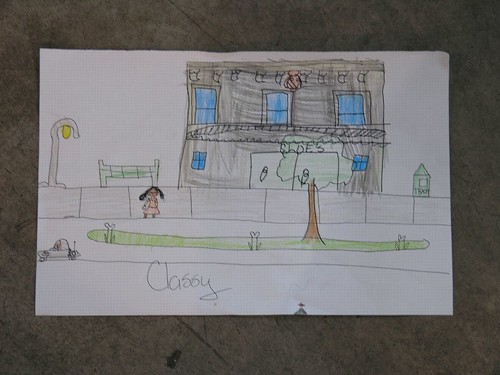
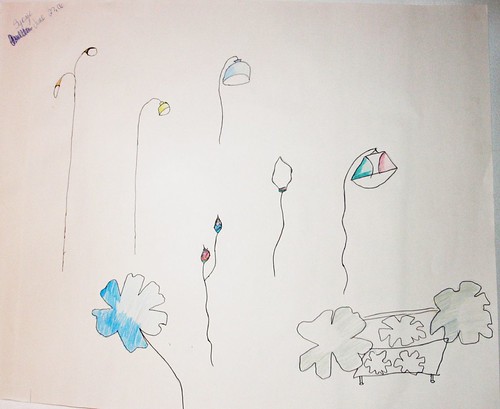
I managed to catch up a bit on what was going on, and did my best to get the younger kids going on something. For this, I broke out the art supplies I had brought down from Boston. After walking around and taking pictures on Oretha Castle Haley Blvd. and while focusing on the words that Steven had them come up with, the younger kids sketched up some ideas for what could go in some of the empty lots and buildings, as well as ideas for what could make the neighborhood better. Some of the students' work: 1, 2, 3. (more on flickr.) It was a bit messy, but fun. There was this wonderful kid, Syraje, who started designing artistic street lights and matching benches for the street. Unfortunately, he was only there for one day.Lisa Mosier taught the older kids how to do models in Google SketchUp, while I was working with the younger kids.

The next day, only three of the younger kids showed up (in addition to the older kids). Dorian Hastings showed up and gave a wonderful presentation on the history of the street. Glorianna, again, was great with the kids and helped the younger ones think about being entrepeneurs. The three designed their store fronts and what they wanted their stores to have in them. One of them wanted a jewelry store, one of them a clothing store, and one of them a dance/dance supply/dance clothing store. After designing the store fronts, they started designing the things to go in the store. The older kids worked on their 3D models this day. I worked with this kid Garrick a lot on this day. He had some great ideas about how this one block could be, with an internet cafe, some stores, a blockbuster, a drug store, a health center, and a cafe/restaurant with outdoor patio seating.

Thursday. Glorianna left. None of the younger kids showed up. It was pretty much just Micah and Dimitri, the two consistent kids. They worked on their models all day. Dimitri was very focused on doing detail work on the buildings, whereas Micah was more focused on trying to lay out a block. I laid out Garrick's street in SketchUp, since he wasn't there. Work work work on the presentation. Lisa picked out some of the words from Steven's discussion to go in the presentation. I tried to get the kids' input on how the presentation should be structured. While they were busy working on their models, I made the presentation. Well... started it. I didn't finish it until late that night.

Friday. Presentation. Micah and Dimitri were the only ones there in the morning. They ran through the presentation a few times, for practice. Garrick showed up after a bit, and Micah and Dimitri filled him in on the presentation. About when the presentation was starting, two of the younger kids showed up, along with their parents. The presentation went well. I was impressed by Micah's presentation skills. They're better than mine, I think. Dimitri was a bit distractable, and a little soft spoken, and not quite as prepared as Micah, but still did well. Garrick told about his ideas for the two blocks he worked on. And afterwards, the younger kids spoke about what they had worked on.

The parents and other people who showed up seemed interested in what was going on. They asked great questions about the project and about why are we doing this and what all was going on. The kids answered their questions well. And I also answered a few of them, along with Carol Bebelle (of the Ashe' CAC).

All in all, I think this workshop went well. The kids thought through some hard things and came out with a good presentation. I wish we had had more time to work on things, and I hope that this continues and that something comes out of it. I think it was a good experience for the kids, if anything, and I know it was a great experience for me.

03 June 2006

workshops in scotland -- photos!

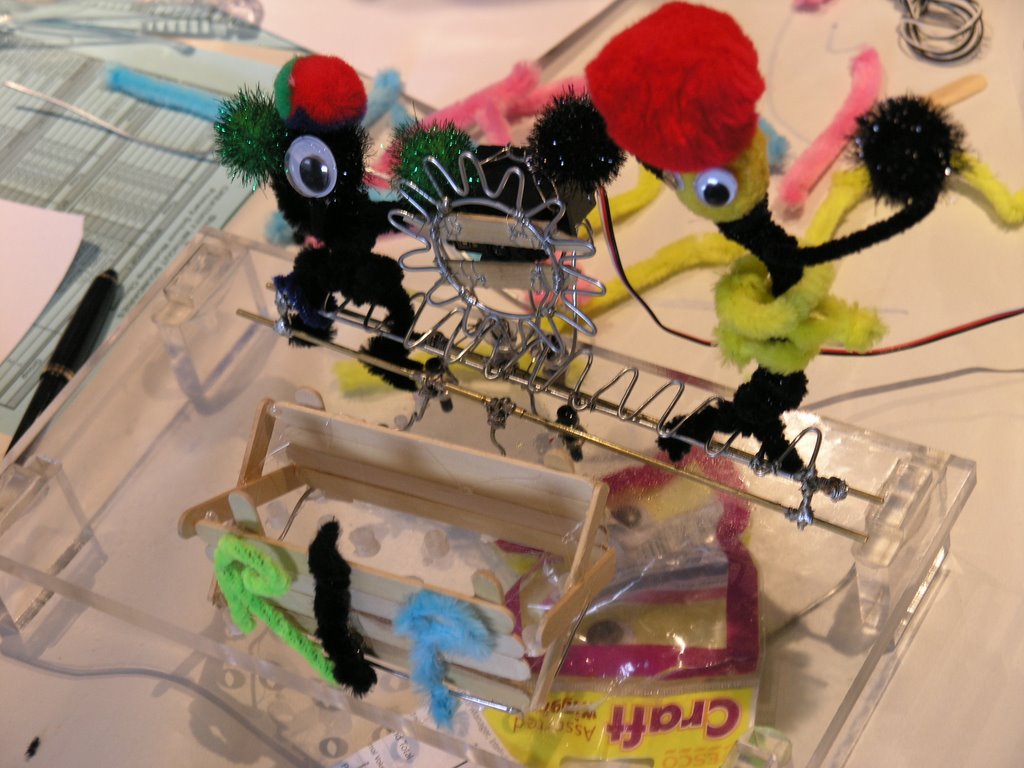
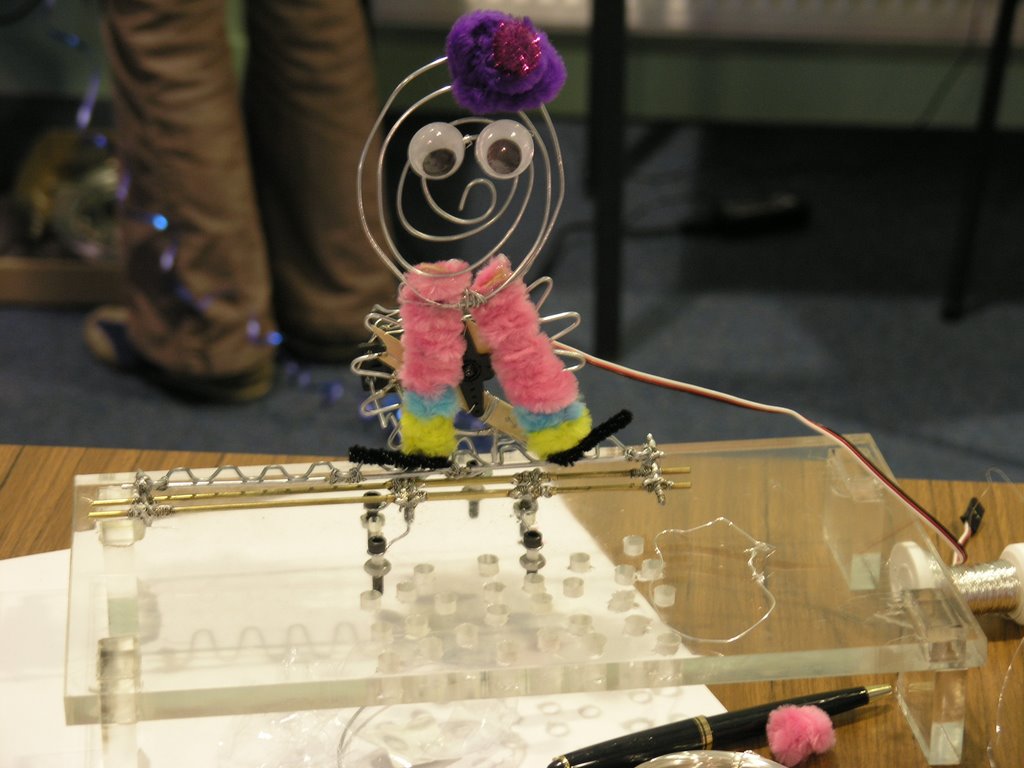
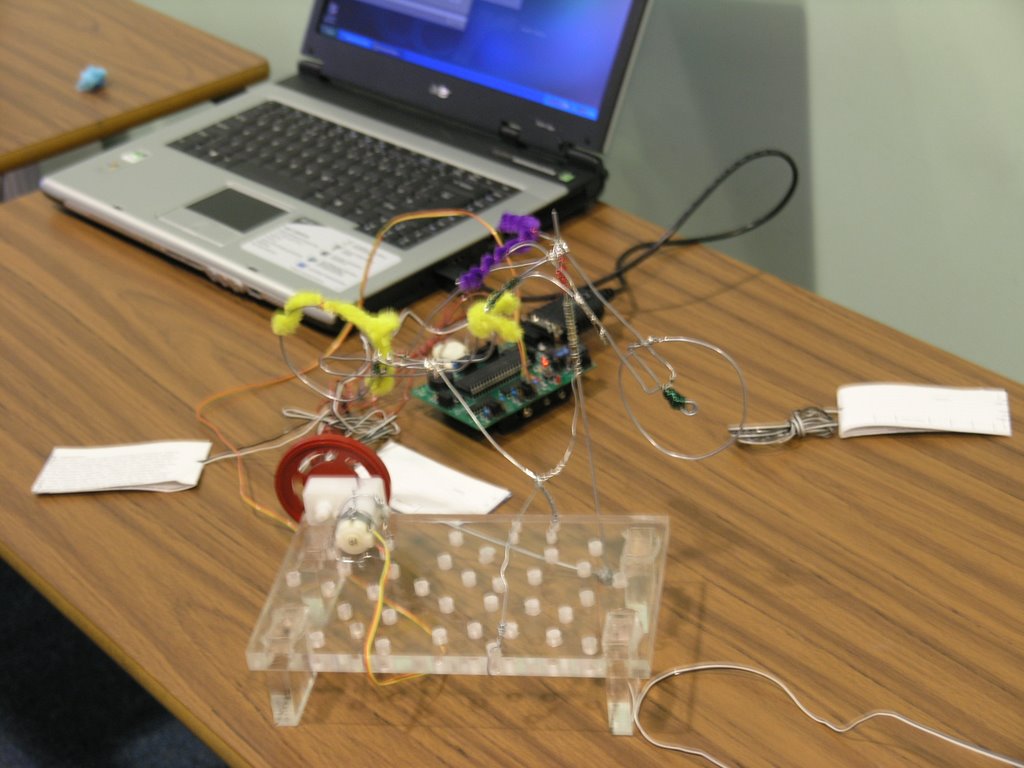
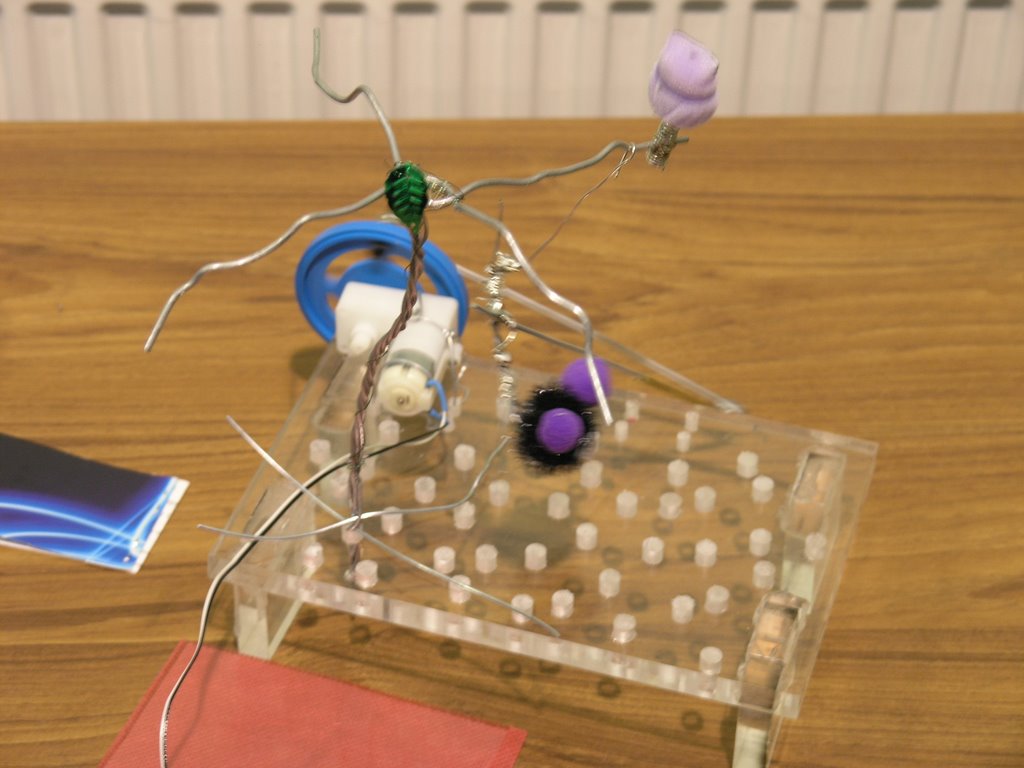
i figure that i should probably show what i've been working on... or really, what the kids in scotland worked on when i ran two workshops over there.


ok. so <- that is supposed to be an angel. this group of two girls made this. they were 9 or 10 years old. it goes back and forth and kind of wiggles.
this -> is supposed to be a skeleton and a gorilla that fight. they originally wanted it to pop out of the coffin in the front, but couldn't figure out how to do that, so they made them fight. when the rack (the thing that they're standing on) goes back and forth, they sway.


this <- is the group that made this clock that says "time flys". it rocks back and forth.


this -> is supposed to be a potato, or "tattie" as they say in scotland. he's wearing a little tam. they made him a kilt, but i don't think they got around to putting it on him.

this <- was made by a group of boys who were in to mountain biking and motocross. they made this motorcycle that rocks back and forth. this is all them, too. all i helped them with was showing them briefly how the mechanism could possibly move and showing them how to solder. for two hours work, i'm pretty impressed.

this -> is supposed to be a monkey swinging on a tree. it's pretty cute when it's moving. they wanted more time to put leaves on the tree and make the monkey swing a little better. but, again, for only two hours, i think they did an excellent job.

there are a few more, but i don't have photos of them right this second. i'll put them up either later tonight or maybe tomorrow. one is of a dolphin, and one is of a robin.

02 June 2006

OPENSTUDIO thoughts

so today, i was commissioned by armando alegre on OPENSTUDIO to make "a drawing that explains why u like so much the blood in living things." i guess i do have some 'splainin' to do.

a couple of weeks ago in response to the appearance of two "museums" on OPENSTUDIO, i decided that maybe what was needed was more gallery curation. and so i started the plan to curate a show around a theme. for various reasons, i chose the theme bloody and set about commissioning and buying art with this theme. why bloody? good question. i guess for me blood has a lot of significance. and i honestly just find it somewhat amusing to make bloody cartoon characters.

we, as humans, place a lot of value on life -- the people most harshly punished are the ones who bring an end to human life (or who threaten the country, but that aside...). this reverance of human life also extends to other living creatures, some people even opting to never eat another (previously) living animal or using anything that might have harmed them. blood is inextricably tied to life. when i was reading "the second self" a while back, i was struck by how kids decide on whether or not something is "alive". more specifically, i was struck by the statement that spiders aren't alive "because we can kill them." which doesn't quite make sense when you get down to it, but in some way it does. on the whole, we don't think twice about killing insects or worms or things like that. maybe it's because they don't bleed. when making art on OPENSTUDIO, i often make things bloody. in particular, i'm drawn to the idea of cute gore. or cute monsters. the ability to show something that would in real life be really horrible but in a way that's estranged from all our connections to real life. it's cathartic in a sense. and by being able to laugh at something, you can begin to become unafraid of it in real life.

when we get an injury, we want to fix it. exposure of blood usually signifies a jeopardy to life; the one exception to this is menstruation. but, still, blood is not part of what we talk about, even though it plays a major role in our every day lives. we grow up watching nature shows where you see the lion hunting and then see the lion eating -- never the lion killing. nature minus the harshness. but, you know, nature isn't clean. it's bloody and messy and fearful. as someone who grew up in the country, i thought nothing of helping goats give birth, gutting my own fish, or of eating an animal i raised, etc. it was part of life. but then i moved to the city. in some sense, the nature of living was gone. i no longer had to fear being bitten by poisonous snakes, the deaths of my animals in the back yard/farm, predators. and i realized how sterile we humans try to make our lives. in some sense, i still feel that living in the city is just... strange.

but i don't think blood and fear and death and nature are things to be... well... feared. they just are. and it's more advantageous to feel capable of coping instead of being afraid of ever having to deal with them. we are mortal but our ideas (maybe according to plato) are eternal. but we shouldn't forget our mortality. we are rational animals, and sometimes it's nice to be reminded of the animal aspect. not everything in our world can be rationalized.

as for a more personal significance of blood, and at the risk of maybe revealing something about myself that i'm not proud of to the entire damn internet (or at least the portion that will see this), i went through several years of being (off and on) depressed and a self-injurer. and in some way, it's cathartic for me to externalize these things. to be able to laugh at myself. to realize that there are things in my life that may not be perfect, but that i always have the opportunity to change. to know that i went through this and survived makes the happiness that much sweeter.

so i guess i'll probably continue to make bloody cartoons for a while. it's a nice way to remind myself of my mortality, and to laugh at it and decide to live, anyway. sport death, maybe, to use the senior house motto.

yeah. sport death. only life can kill you.
it's better to face these things -- blood, death, disease, pain, fear
than to pretend they don't exist.

18 April 2006

part 1 of essay

As computers and other digital technologies have become more integrated into our every day lives, we begin to take the digital world for granted, and in many cases we choose digital over a more material form. Digital media has offered us ease of use, convenience, quickness, versatility, and in many cases is cheaper than the material alternative (especially if one already owns a computer). Digital cameras allow cheap, instant gratification when a photo is desired, instead of the old method of having to wait for a roll of film to be developed and printed. Email allows us to freely and almost instantaneously send our thoughts to anyone around the world who has the ability tof check email instead of having to write out a letter by hand and wait for the postal service to deliver it days from when you sent it. We have digital clocks that can receive a radio signal from the atomic clock and adjust the time accordingly. We can have our music wherever we go. We can watch movies or the news on our iPods. Technology is so integrated into our daily lives that at some point we begin to take it for granted not only as simply being present, but also as being a good thing in our lives. We should stop to consider how having these things around have changed the way we think, live, and interact – not every impact technology makes or has made is positive.

I'm not trying to vilify technology, though. Technology has undoubtedly made a huge positive change on human life – the wheel, irrigation, electricity, water filtration, etc. But these are not new technologies. What I'm more concerned about is everything from the industrial revolution onward, and in particular computers. But, still, I'm not trying to vilify the computer; I just want to be conscious of the effects of technology's use on myself and on others. To quote one of Seth's blog entries:

I am not denying the utility and benefits that computers have brought to my life, and many others, but I am rather recognizing that there are times when the computer does not benefit me. It can impair my health, keep me awake, waste my time, and reduce my interaction with other humans. So, I would like to minimize these things without denying that procrastination, games, and frivolous interactions can also be beneficial.

To further clarify, I believe that the technology itself cannot be good or bad, but only our use of it can be valued with words such as good or bad. Existence is beyond evaluative words; it is only in our perception of an object's or a person's existence that the evaluation of good or bad comes in. Existence precedes judgement; in the end, technology is simply what we make of it, and it falls to us to be responsible about its use. Existence precedes use; it is only when we are presented with existing materials that we can judge them and then either put them to use as they are, or else reshape the materials to fit the use we have in mind. In simpler words, technology's not the problem; the problem is us.

27 March 2006

rambling philosophical musings that probably don't make much sense right now.

i really should get better about writing in this. i keep coming up with so many things to say, but only end up having the time to say a few.

philosophy has been on my mind. in particular, why do i find that i have such a strong reaction against plato? and why do i tend to agree with aristotle more. well... at least when it comes to the ideas behind aesthetics.

plato. oh man. plato. so much there (of what i've read) that gets to me. first off, i guess i tend to read his argument against allowing mythologies to be told as an argument for canon and for the side of media effects that tends toward children can't tell the difference between reality and stories. a similar argument is going on now with games vs. reality. and earlier in the 80s with D&D. and i suppose it will always go on.

maybe i should clarify. plato takes the stance that falseness is bad. in all its forms. and i disagree. sometimes a lie is more capable of telling the truth. and i think that this stance has appeared throughout art history and comedic history. satire. dada. the daily show. and he argues that children need to be protected from this because they don't have the capacity to discern the difference between truth and fiction. i don't think so. i think kids are often smarter than we give them credit for. and instead of deciding to censor things, it's better to have open discussion about controversial things. not talking about it only serves to cause a festering wound.

and maybe i just tend to bristle at the idea that he has the right to tell people what is and isn't worth studying or reading. but maybe that's me coming from my own stance of hating it when people do this to me. maybe i just feel that anything that you're interested in, if examined deeply and thoroughly, can lead to a develpment of critical thinking and also build up and branch out to other topics. for example -- the main reason that i started studying the history of modern art has its roots in my love of punk music and many hours spent on the internet reading about the history of punk music and related subcultures. i'm sure plato wouldn't think punk music is a valid form of study.

i also tend to disagree with him when it comes to his idea of imitation and images. that true art is when an artist produces a true to life representation of an object. but that the replication is somehow secondary to actually making an object. i feel that he wrongly puts aside the subjective. everything leads towards the objective. and everything has its perfect ideal.... platonic ideals. pah. this is not my cup of tea, nor do i think he's right.

aristotle, on the other hand, i think has a better feel for subjectivity, and in particular, the thing-y-ness of things. how without materials, there would be no production of any objects. he, too, disagreed with plato. maybe it's just a nice change after hating plato for the past few days.

one more reason to hate plato:
his discussion of who should be allowed to tell a lie. he argues that the state is the only one who should be allowed to tell a lie if it's "for the public good." i don't think this is right. the public should decide the public good. the public should be informed. the public should care.

and, sadly enough, i don't think the public is informed ... i know i'm not.
people shouldn't be afraid of their governments. governments should be afraid of their people.

10 March 2006

double oh seven

so one of my friends is in 2.007 at MIT and sounds like she's having a lot of the same thoughts i had when i was in the class. in some ways it's good seeing that i wasn't the only one who wasn't overly thrilled at this class. but it's also bad in other ways because i remember very clearly how miserable i was there.

everyone in the class and everyone involved with the class seems to act like of course you want to compete and win... that this is fun. it wasn't fun. and i didn't really learn anything in that class. wait. i should change that remark. i didn't learn what they expected me to learn. i learned about myself. and i learned about what i wanted. but i didn't really learn design. i didn't learn design until i started working on things that i actually cared about. the main reason i hated 2.007 -- everyone acted like they thought i should be passionate about this and i hated myself for not being that way. i kept thinking there was something wrong with me for not enjoying what the other students seemed to find thrilling. and that made me feel like a bad engineer.

there were no other options; either i wanted to compete and win, or i was wrong. it never really dawned on me then that maybe i wasn't a bad engineer at all, that maybe they weren't presenting the material in a way i could get. the professor just seemed out to try to be considered cool by the students. lectures were manic. i couldn't follow anything. not to mention, teaching design in a lecture setting is pointless... at least for me. i can't understand things unless i can feel them... can play with them. and by the time i got back to the lab, i was so distracted by the prof's antics that i couldn't remember anything anyway. so i stopped going to lecture. the textbook wasn't helpful either. and my lab supervisor was completely unhelpful. so what was i left with? no support. and students who thought i was wrong. and then i just got laughed at for being "too artistic."

dear GOD i hated that class. and now one of my friends is there. and i just laugh (not in a condescending way... in an understanding way) that she's really just wanting to make some sort of kinetic sculpture. cause i was there. and i somehow made it through. and it's hard to fight against an existing way of teaching for something that's equally, if not more, difficult and valid. but you learn so much more when you care about what you do. i want her to care. and i want her to be happy. but most importantly, i want her to realize that following what you're passionate about (in her case, wanting to do something not to win) is important and that even if a whole bunch of people give you rules, you should just find ways to work around/within them and still do what you want.

01 March 2006

The redesigned.

Four readings on media literacy for Henry's class - 1) Pedagogy of Multiliteracies - Bill Cope 2) an excerpt from James Gee's Cultural Models 3) David Buckingham - Telemedium - Will Media Education Ever Escape the Effects Debate 4) Rene Hobbes - The Seven Great Debates in Media Literacy

And I must say, good readings. I'm still trying to digest exactly where I stand in this whole thing. Actually... I guess it would be more accurate to say that I'm pretty sure of where I stand, I'm just not sure how to support my stance and articulate it in an intelligible manner.

So, hey! I'm gonna give it a try.

"As educators, we have a greater responsibility to consider the implications of what we do in relation to a productive working life," (p. 11). (Oh man, do we.)

The first reading struck me hard and I think ties in with my work. It talks a lot about the current economic trends and ties them in with why media literacy is important. Cope then goes on to argue that even though we're now in the era of PostFordism, where companies have changed from models based on hierarchies and specialization to models based on flexibility and flat hierarchical structures (i.e. teamwork), a lot of things haven't changed. And a lot of things have. Economic models now use terms that used to be only related to education. There are now "knowledge workers" and "learning organizations." "These examples of revolutionary changes in technology and the nature of organizations have produced a new language of work. They are all reasons why literacy pedagogy has to change if it is to be relevant to the new demands of working life; if it is to provide all students with access to fulfilling employment," (p 12). Media literacy is important because so much of this new world ... these new economics ... hinges around media. He then warns educators to watch out for any remake of pedagogy being assimilated by economics. "As we remake our literary pedagogy to be more relevant to a new world of owrk, we need to be aware of the danger that our words become co-opted by economically and market-driven discourses, no matter how contemporary and 'post-capitalist' these may appear," (p. 12).

He points out that even though many things about these new strategies may seem informal and more person-to-person... multifaceted... etc, that they still maintain a ceiling. Except this time it's the 'glass ceiling.' "For anyone who is not a comfortable part of the culture and discourses of the mainstream, it is even harder to get into networks that operate informally than it was to enter into the old discourses of formality," (p. 12). For me, this (again) points back to Baudrillard's simulations. A simulation of economic freedom, when really, it's all about who you know.

"It may well be that market-driven theories and practices, even though they sound humane, will never authentically include a vision of meaningful success for all students," (p. 12). Yes! The school is not a market; stop treating it as one. This very much ties in with Illich as well as Dewey (the latter is cited by him, actually, so I would hope he takes his view).

And if there was any doubt about this guy's intentions, they left me here: "[...] indeed, in a system that still values vastly disparate social outcomes, there will never be enough 'room at the top.' An authentically democratic new vision of schools must include a vision of meaningful success for all; a vision of success that is not defined exclusively in economic terms and that has embedded within it a critique of hierarcy and economic injustic," (p. 13). That's very much a view of mine. It's slowly been sinking in. We were discussing doorknobs -- more specifically, the redesign of doorknobs -- in Glorianna's class. One suggestion was not having a door. Someone sounded shocked that you could have things stolen or that you would have no privacy. I guess my thought on that matter is... things are just things. They may make my life easier, but how can I justify my own ease over the needs of others? How can I feel happy in my situation if those around me don't have the same situation? And privacy... well... isn't there that saying that a measure of a man's character is what he does when he's sure no one is watching? I mean... if I'm not comfortable enough with what I'm doing to show other people [for the most part], then why am I doing it?

[shrug] that's a bit of a sidetrack. I think a lot about the boundary of public and private as well as the whole thing involving property... and I'm still trying to nail down exactly where I stand, and to try to fix where theory doesn't line up with my own practice.

But I think he's right, regardless, that "An authentically democratic new vision of schools must include a vision of meaningful success for all' a vision of success that is not defined exclusively in economic terms and that has embedded within it a critique of hierarchy and economic injustice." Democracy -> every... every human has a say. But I think the (perceived) problem lies in his use of 'meaningful.' I don't think that people with things want to give them up, because they've lost view of what's meaningful. Or maybe meaning is such a subjective term that people don't want to give their world over to subjectivity.

"This is not just so that educators can provide a better 'service' to 'minorities.' Rather, such a pedagogical orientation will produce benefits for all. For example, there will be a cognitive benefit to all children in a pedagogy of linguistic and cultural pluralism, including the 'mainstream' children. When learners juxtapose differend languages, discourses, styles, and approaches, they gain substantively in metacognitive and metalinguistic abilities and in their ability to reflect critically on complex systems and their interactions," (p. 15). I definitely agree with the argument that people from the earliest age, should be involved with interactions from different races, different backgrounds, different cultures, different ages, different genders. It helps promote a balanced views... or maybe it's more that people won't question their beliefs if they're surrounded by people who agree with them. It's crucial to question beliefs, especially at an age where you're not so entrenched in your own ways that you can't possibly understand anyone else's view.

And this, I think, ties in with Gee's arguments about cultural models. In particular, his example of the video game where you play through as a Palestini boy who throws rocks at soldiers and who is trying to get to temple. Because video games put you in such an interactive space, you're able to try on a different cultural model. We didn't question the violence against Arabs in American video games, but as soon as there's this Palestini boy throwing rocks at Israelis, then we question it. Our cultural models clash. But, perhaps, it's quite important that they do clash. Having the ability to try on cultural models opens up the discussion about our own cultural model. And I think having a classroom full of different people -- race, age, sex, culture -- is important for the same reason.

And... I think this gets argued in the first article, just not in terms of cultural models: "To be relevant, learning processes need to recruit, rather than attempt to ignore and erase, the different subjectives, interests, intentions, comitments, and purposes that a student brings to learning," (p. 18), and
"Through their co-engagement in designing, people transform their relations with each other, and so transform themselves," (p, 22).

ooookaayyyy. so where does that leave me? Arguing for diversity and elimination of class. For individuals over the whole. Realizing the need for change. Realizing the need for educational models to change. For wanting us to admit to the simulation and to try to do something about it.

There are other arguments in these readings, but they'll have to wait til tomorrow.

24 February 2006

more random thoughts on the matter

after talking to mr. j. barabas last night, i realized that maybe i should clarify my argument. i'm not saying that there should be an absence of theory... i'm more saying that there should be less of an emphasis on it. and i feel that this has been said over and over again by various people. there should be theory with method. no just method. no just theory. and people should stop being told that one is more valuable than the other... that you're "smarter" if you're all theory.

action! it's all about action. experience your experiences... don't just listen to other people talk about their experience, or worse yet... listening to other people theorize about experiences they didn't even have.

coming back to my own experiences...

i really hate it when i hear people saying "oh... you must be talented" after seeing my drawings or my art. no no NO! i've been devoting a large portion of my life to doing this since i decisively made a choice to do so when i was around 4 or 5 years old. everyone has the potential to do it. the only way you get good is by actually doing it. i do it because i care about it. i do it because i can't live without doing it. i'm only (somewhat) good at it because i do it.

so stop thinking that you can't do things.
go out and do them
everyone sucks at the beginning
it's just easier to get away with sucking at things if you're a kid.

sometimes i think that the smartest people of all are the ones who just shut up and get done what needs to get done. the people who always have a knack for figuring out the right thing to do. maybe it's all just a matter of listening.

23 February 2006

chautauqua

so my coffee mug is sitting here perilously close to my laptop, but i'm attempting to have faith that my desk isn't as messy as it really is and that i'm not a complete klutz. maybe these are bad things to have faith in.

either way, i've realized that i should write in this more (instead of only writing it down and never showing anyone). hm. so here it goes -- several days' worth of me writing in my notebook.

------


"information is semantic in nature" -- thing knowledge (p. 68)

*semantic - of or relating to meaning (esp. language)
*epistemic - of or relating to knowledge


so where does this go? i'm not sure. i've been trying to grasp the whole connotation of semantics and epistemics and the ologies of them both. coming at theory from a hands-on standpoint is hard, but doable, i think.

i've discovered that i really like reading about art history and the theory of art and aesthetics. and when i say reading, i don't mean lazily flipping the pages, staring at pictures. no no. it's more reading, as in arguing my own view along the way and sometimes changing stance in lieu of new information or a new way of thinking of things. (and i definitely don't think reading about art is a waste of time if you're an engineer... but maybe that is a different argument altogether and should be saved for a different day)

anyway. i was reading this book about kandinsky (the "inventor" of abstract painting) (ISBN 0-517-64793-1, in case you were wondering) the other day and ran across this quote:
"like many another artist at the turn of the century, kandinsky was a prolific writer." and that's the beginning of all of this. a nucleation point, if you will, of things that have been floating around in my head for a few weeks.

"poets, philosophers, academicians, scholars, and critics routinely issued their analyses and pronouncements on the contemporary artistic scene, but always from the perspective of someone not himself directly involved in the pictoral process."

in other words, writers of criticism/critique wrote about the works of others. producer of media and theoretician of media are separate.

"for the artist, understandably, the effect was to make him wish to resume control of his own destiny, so that he felt an increasing obligation to take responsibility not only for his creative activities but also for the reception of his work by the public. he was forced into the position of becoming a writer himself."

the artist feels a loss of control over how his works are viewed because the artist isn't the one writing about his own experience -- an experience that takes place in a space that may or may not originally be thought out in words.

"[...] it became difficult, if not actually impossible, for the artist to explain himself through a third party. if he were not to be misunderstood -- or willfully misrepresented -- he had to take the risk of entering the lists as a theoretician on his own behalf. for kandinsky, the forming of images had to work hand in hand with the formulation of ideas."

kandinsky's action to take responsibility for his own theories says something important. he realized that art and words (mostly) exist in two different worlds; art cannot stand on its own -- at least because people don't know how to read it. if we were trained in reading art -- something that i think comes in part from producing some form of art -- then it's easier to interpret (to a closer extent) what someone else is trying to accomplish. this is simply things vs. words.

"necessary allies, the two processes [writing and painting] complement each other in pursuit of greater clarity."

"yet they are far from being interchangeable. the words do not provide a key to the images, nor do they set out a programme which the images proceed to illustrate"

the object -- in this case kandinsky's art -- "says" things that theory alone cannot. they must exist together. the paintings have some knowledge inherent to them that's more than theory -- something wordless and immeasurable. something that can only be grasped through seeing the work. from this, i would venture to say that kandinsky realized that there are things in art that are inherently wordless. also, that during the production of a work of art, most of the communication between creator and medium happens in this wordless place. because kandinsky knew that the grammar of art was not enough to describe his goals, he tried to use the language of music to describe his work.

"'music has a grammar,' he wrote, 'a grammar which, like any living thing, changes over long periods of time, and yet can always usefully be referred to, much in the way you consult a dictionary ...'"

i say that a lot of music's grammar is determined by the materials -- instruments and performers -- involved. and that the act of performing a piece changes the way subsequent pieces are produced and performed. because materials and people change over time, music and the grammar of music has changed.

"kandinsky was first and foremost a painter, and one cannot look at what he wrote without bearing that in mind. the theoretician cannot be regarded in isolation from the artist. in the last analysis, the writing is only a secondary response to the primary matter of painting. kandinsky's texts must be read, therefore, as attempted rationalizations, both as tentative and as contradictory as the progress of the work itself, valuable only in so far as they ar a record of his determination to spell out a truth about painting."

yes! the painting exists before any concrete thoughts about the recently produced painting are formed. material precedes theory. practice precedes theory. writing is secondary to the work. this lends credence to the thought that there is a knowledge that can be gained only through the experience of producing something, and that although we (as a culture) put a higher value on theory, theory cannot exist without these objects coming first. thus, through theory and words, we are only verbalizing what was already inherently present in the material and our production of an object. or maybe it's more that hte object is a manifestation of the change that has taken place through the experience of ecreation, and that this change -- of materials and of the creator -- is something that has taken place outside of words. it's a silent understanding between material and creator ... a compromise and a conversation.

this is what i mean when i say that a creator has to listen to the materials. there's an understanding -- a physical understanding -- that's transferred without words: the feel of the pen on the paper, the strength of the material, the flow of water and paint on a canvas, the feel of metal bending into shape ... it all adds up to a whole greater than the creator's original vision.

"he [kandinsky] was already losing interest in reality and the natural world, which made so little impression on him that his whole concentration was focused on the surprising forms assumed by the thick pigments, modelled under the broad strokes of his palette knife."

i would argue that kandinsky discovered the wordless communication of the medium (in his case, paint) and became enamored with it... wanted to explore it, and it alone. that in forgoing the attempt of representing the "real world," he discovered communicating the process of creating -- communicating the subjectivity of creation... the state of mind whilst painting, the paint under his palette knife moving in its own way according to laws of physics that are still only somewhat understood, etc. and he felt that since he alone was there for the entire experience of creation, he was the only one who was able to truly attempt to put this experience into words -- hence, his writing and theoretizing about his own work. he felt the quiet mystery of wordless communication in creation and sought to vocalize and rationalize it. but his writing still cannot stand separate from his work. so much is communicated in this wordless world that it's impossible to communicate everything with words. this is one reason that i think the only way to truly understand something is to do it yourself.

the conversation between creator and materials is then embodied physically in the creator and the material -- both have changed after this process. i think sartre agrees with this in some respect :

"when we speak of a canvas of picasso, we never say that it is arbitrary; we understand quite wll that he was making himself what he is at the very time he was painting, that the ensemble of his work is embodied in his life" (sartre, jean-paul. existentialism and human emotions. 1987. p43).

this speaks to the change of the creator and, i think, ties to how this change is also embodied in the work. the works are relics of constant change. i would also propose to argue that even though kandinsky forewent depicting "real life" that his creations depict reality -- but in his case, the reality of the materials and the reality of subjectivity and experience. the reality of the creator without words instead of the readily observable reality.

and i think it's this point that draws contention. people are wont to believe in what can be measured and observed. moreover, people want to disbelieve and discredit the subjective, even though (i believe) most of our thoughts are composed from wordless knowledge and not theorized words. but the subjective is real; people just want to be able to ascribe predictability and rules to all things. anything that cannot be given rules and put aside in a little marked bin is "not scientific" or "not rational." if this is their argument, then their "rationality" is flawed.

if experience could be transferred completely with words, then there would be no need to distinguish who does what work. reading a book on something would make anyone an expert. but reading a book on someone does not make you an expert. no one will argue with this. if all knowledge could be transferred in words or in images, then there would be no use for experience. but our world is experience driven. experience has a marketable value. therefore, we shouldn't try to substitute theory for experience. experience has no substitute.

gundela (one of my housemates) says i should clarify a few of my points. the main one being, how much the creator's original vision comes into play when designing something.

it would be wrong to say that it's one way or another -- process or goal. more likely, it's a continuous spectrum. i would also venture to say that no design process is completely goal driven. maybe in the simplest and most abstract form... yes... but not in how the design is carried out. something can only be 100% goal driven if the designer/creator completely understands the materials and the method, and even then, there are so many possibilities, that something will be different than planned. so 100% goal-driven is not a possibility. likewise, 100% process is also unrealistic. something had to set you about making something. even if that goal is to explore the process, it's still a goal.

so i would say that there's a spectrum from pure process to pure goal with the ends being theoretic limits. the majority would lie somewhere in the middle. abstract art on the process side, and engineering design more on the goal side.

so what does all this mean? well... first, that i think people who identify as artists are more likely to understand how the material has a play in design -- particulary sculptors and wood workers. and i think that the more experience someone has with materials, the more able they are to choose which materials/media should be used to get done what they need to get done (if they have a goal). from this, i would say that engineers should also understand materials. engineers who are familiar with materials are more able to design a stable and useful (if useful is what is wanted) structure/mechanism/etc.

so i think it's imperative that all people understand materials, because materials surround us. and i believe that the only way to do this is to work with a variety of materials that are readily available.

i once read somewhere that "engineering is making what you want with what you have," and i think that this statement holds a lot of truth. to me, this means that an engineer needs to understand the materials in order to arrive at a design that satisfies the design constraints while also satisfying material constraints. the engineer should understand the material enough to use the materials properties (both strengths and "weaknesses") in positive ways. like i mentioned before -- using the wire's flexibility as a way to make it stronger for larger structures.

i also think that it speaks to the fact that engineers -- people in general, really -- would create better, more locally customized and sustainable design if they understood the materials surrounding them. and everyone would benefit. maybe this is overly idealistic. but, really, people should explore their worlds and should feel comfortable taking everything that's around them and using it for their own means. appropriation. it's all about appropriation. and somehow, i think, appropriation is all about confidence and comfort.

18 February 2006

09 February 2006

really, i'm not a crazy engineer.

so it's thursday. classes have started, and i'm so happy to be going to them. i think they'll be very good for me this term. i almost feel like i've become a real and somewhat (more) responsible person.

class 1: special topics in cinematic storytelling with glorianna davenport. first day of class, we got to tell a story. the reading list is good. the people in the class are a nice mix. and glorianna looks so happy to teach. it's her last time, she says. so i guess it's good that i get a chance to take this.

class 2: media theories and methods II with henry jenkins. henry is awesome. the class dynamic is strong. there are lots of good discussions that go on. the reading list is also awesome.

-----------------------------------------------

"The simulacrum is never that which conceals the truth -- it is the truth which conceals that there is none. The simulacrum is true." -- from Jean Baudrillard, Selected Writings, ed. Mark Poster (Stanford; Stanford University Press, 1988).

first week of class, and i'm sure i have some thoughts to go along with it. i've been reading about fair use and american copyright law and i keep getting angrier about the state of things. i'm tempted to agree with baudrillard's argument of the simulation of freedom... the simulacrum. i also started reading "thing knowledge." am gonna read some foucault and some more dewey. maybe i've discovered my hidden love for philosophy. maybe i've discovered that i actually care about the state of things than i thought i did. maybe i'm getting over my skepticism and cynicism and am actually trying to do something about it, because anyone can sit around and wank about how things suck and about how they used to be so much better back in the day. words are cheap and thoughtful actions are rare.

maybe sometimes it's better to start doing something and to try and remain confident that you can figure things out along the way. it's better to be confident in your abilities than to be confident in your ability to predict the future.

anyway. back to that whole doing stuff thing.

i started building some dancing flowers. simple. made out of scraps of stuff i had around as an exercise in mechanisms and building stuff with wire. i don't think there's much better of a way for me to do this other than me doing this. it feels like working with the material speaks so much more than i could ever theorize. in some way, it's nice to give up control in favor of something that would work better with the material. i don't know if that statement made any sense. basically... i can only plan so much before building something. after that, everything has to come from experience. i'm not old enough to have the design experience of a mature engineer, but i'm flexible enough to admit that i don't. and i'm flexible enough to admit that sometimes the material knows (in a sense) more than i do.

maybe i sound crazy when i say this, but i think it's an engineer's job to listen to the materials and the situation and to be willing to admit that their planning is sometimes not enough. it's not an engineer's job to forcefully work out a situation. there has to be elegance and grace. in particular when working with nature or trying to create a certain motion.

does that make sense? i realize that sometimes i ramble and that sometimes things make sense to me when in reality i'm leaving out a bunch of explaining.

maybe i should expand on that.

too long, engineers and industry in general has tried to forceably make what they want to have happen instead of finding the best solution with the materials available. this leads to excess and over engineering and a whole host of other things. i can't see technology without any sort of philosophy or ethics or art, and i don't know why it's not taught as being inextricably tied together. i also hate the way people put themselves above nature. the world was here before us and the world will be here after us. it's prideful and foolish to even pretend that we can predict and control things. what we CAN do, though, is listen to the situations... to the materials involved. instead of trying to find the best materials from the farthest away to create the "perfect" model of something, we can find local materials and create the most effective local model.

for me right now, i have a lot of wire around.
its strength is its flexibility
its strength is also its weakness... i.e. it's hard to build larger structures out of it
but if you use its strength as a solution to its weakness (by wrapping lots of wire together in certain manners and soldering/welding in key spots), you can end up with a pretty stable structure.

this solution comes from simply listening to the material and using its strength.
likewise, the same should be done for other materials.

21 January 2006

i hope i don't offend anyone with this

So i'm eavesdropping on this conversation to my right. A circle of people who talk about nothing like it's a big idea and who continuously pat themselves on the back for even talking about these things. Generalities without meanings. And i'm finding that the more i hear, the more i hate everything they're saying. It's one woman in particular. She's discussing with some school representatives about them having prom and homecoming dances. More specifically, she's disagreeing with them about letting the kids have these dances (the school didn't originally have them). Granted... as much as i hated school dances, i think that if the kids want them and if they are willing to go through the process of organizing things, then they should be allowed to have it. The woman from the school claims (and i agree... with my own thoughts that will be added later) that the process of organizing and figuring out things can be a learning experience. The woman in the crowd (if a crowd is three people) countered that this process of figuring out and organizing the dance takes away from the kids' valuable time when they could be learning other things and that the learning experience involved in such an activity would be all of five minutes. I figured since their words illicited such a strong reaction from myself that i should examine why it is that i feel strongly and exactly what it is that i'm respoding to.


First off, the way that the woman in the crowd talked rubbed me the wrong way. She was saying things like they were 100% the truth because she's a teacher and she knows what these kids need blah blah blah blah. Stereotypical in some sense. I felt that she was speaking with false authority and with false pretenses. Someone regurgitating what they've always done because that's just the way it is... someone i don't feel has put enough of the right thought into what she was saying. To use Seymour's words, someone making excuses for the QWERTY keyboard even when the real reasons have long since gone. I find that when anyone speaks like that, i immidiately take offense. What gives her the right to dictate from high what the kids do or don't want or need? I hate this tone of voice mainly because it implies that there is a clear right or wrong and that one person alone can know “what's best” and that it's their duty to make sure everyone else is convinced that their way is right.


I truly and honestly believe that, just like the design process, there is not only one solution. Different solutions work better in different situations. It's not our job to duplicate... to replicate... to unthinkingly create something mechanical... to push kids through one mold. It's our job to figure out how each individual thinks, how they learn... to figure out what they're good at and what they care about and to help them incorporate useful skills into what they already know. To aid in their own personal appropriation of knowledge.


Building on this, why can't the organization of a school dance be something just as learning rich... possibly even more rich... as what's considered a more traditional route? If it's claimed otherwise, then the claimant (claimee?) is not thinking... not dreaming... not pushing. everything is a learning experience. Just think of what a school dance could be if people dreamed more about them instead of simply trying to recreate last year's dance with a new theme. There's no reason why technology couldn't be integrated. Movement. Robotics. Sensors. Documentation. Story telling via blog/DV... etc. And with a simple desire for a dance, a more meaningful experience could be created. But most importantly, it was something the kids themselves created from their own desires. The results of that experience cannot be measured. Confidence. Creativity. Self-esteem. Things that are immeasurable and that lead to more in-depth and more meaningful learning.


I guess I just can't see why people think that they have any right to say that one way is best, that there's only one mold, that there's only one path to take. Why is what you do more meaningful than what i do or what someone else does? It's not.


I got into an argument with one of my friends the other day about originality. They were arguing that if people take the viewpoint that no act is original, then there's no purpose to live for. (they were arguing that everything was original.) My argument is that no act is original (at least not when you break it down into the simplest concept of what that action is), it's just that every human is a sum of so many experiences and choices, that the order in which they happen (if they happen) and the way that they happen is original for every single human. Our gestures may not be unique, but our whole selves are. It's not right to try to force an experience on someone because they might not be in the right place for that. Maybe their path in life has been so vastly different from your own that you cannot make sense to them. But nothing gives you the right to say that your own personal path is the only right way to go, simply because you think so highly of yourself that you think you turned out whole, complete, and ok. Life is a process that all ends in the same goal, and every process is different. Every process should be allowed to be different.

(david says i can't change everyone)

17 January 2006

ganson/kinetic sculptures/other thoughts

last thursday, i met with arthur ganson to discuss my work and his work and things in general. it was pretty awesome.

i'd be lying if i said that arthur ganson's work hadn't influenced my own work. i remember the first time i went to the MIT museum (about four years ago) and saw ganson's permanent exhibit there. i was awed and excited. something about the pieces captured my imagination and opened a world to me that i never knew was possible. that was the engineering i always dreamed about. there was mechanical logic out in the open. there was the (to use ganson's words) sensuality of machines. something there was mystical and playful. and i loved it.

my undergrad mechE senior thesis (the icarus machine: a kinetic sculpture that demonstrates the principle of gyroscopic precession) was inspired by ganson (and also elizabeth streb and robert m. pirsig's book zen and the art of motorcycle maintenance). other than my inspirations, my thesis was fueled by the fact that i took an entire class that focused mainly on gyroscopic motion and was still clueless when it came to intuition about how they actually worked. i thought that by working through the design process, that i might come to a more clear understanding of what was going on.

over half a year since i finished my thesis, and i don't know that my intuition about gyroscopes is really superb, but it's definitely better than it was. but i think most importantly the process of working on my thesis has shaped the course of where i am and where i'm going in my life.

which somehow (at least in my head this makes logical sense) leads to my meeting with arthur ganson. i had lots of questions for him, but somehow the answers to the pre-thought questions weren't that important (although, he did patiently answer everything i asked). for me, what was more meaningful and rich was the conversation that went on between and through the questions. so i'll try to go over the questions and answers and fill in in between what i remember but didn't quite write down, as well as add a bit of my own post-meeting thinking. [the beginning questions in quotes are what i asked him]

-- "why 'gestural engineering' as a name for your exhibit at the museum?"
the museum folk are the ones who came up with this name. gesture is tied clearly to what ganson is doing. as he explained to me, "gesture is our emotional response to motion." i very much agree with that statement... or what it implies. maybe it should be more clearly stated that the gesture of a motion produces an emotional response. for me, the mention of gesture brings my thoughts to milan kundera's book immortality. in this book, kundera opens with a gesture that an old woman makes as she gets out of a public swimming pool. kundera discusses how this gesture belongs to a twenty year old girl and how gestures are not unique -- there are few gestures and many people. this thought fits with my view of the engineering design process, i.e. there are a set number of things to get done... motions to make... and many ways to do it.

-- "what is your design process?"
in general, the process is started by thinking about the type of motion that the final machine will make, then thinking about the possible mechanisms that can produce that motion. sometimes (as with the artichoke petal), the object works as a catalyst to start the design process. and yet other times, the idea is more nebulous, e.g. the fragile machine ... "its presence is its gesture." the mechanics of the machine is directly connected with how something will work and with the materials that will be used. this makes sense to me. to get a desired presence, a desired gesture, it's important to understand materials and the different uses of them. every material has its plusses and its drawbacks. for example, some materials allow for ease of construction, but offer little ability to scale to large size (lego is one case of this). so when the gesture is decided upon, it also follows that a certain set of materials will soon be decided upon. delicate gestures require delicate materials, etc.

-- "what resources do you use for mechanism design?"
mostly, he just sits, ponders, dreams, and draws. the more you work on this, the more your intuition about what might be a good solution grows. in the case of the large scale chair that disassembles and comes back together, arthur consulted an old book of mechanisms that he had and found a great solution (the beaver tail cam). i don't know that i could describe that solution here... it was something i didn't understand until moving the actual mechanism and figuring out what it was doing.

-- "what inspires you? what's your goal?"
he's inspired by anything around him and by nature (which... i guess is something around him). his goal is to explore different worlds. the machine is a game. the goal is to always keep playing. i agree with this. by making a problem into play, you eliminate the ingrained worries of is this right or wrong. instead, you focus on trial and debugging until you get what you want... or at least the closest you can get within your time constraints.

-- "what do you use for the base of your sculptures?"
a lot of times the base is incorporated. a good material is MDF (medium density fiberboard). he likes it for its lack of grain and its ability to accept stain. on top of the dye, he adds a wax coat to protect the wood. after researching MDF on the internet and just as a note, MDF should be worked with in high ventilation and with a face mask because it's bonded with urea formaldehyde which is not good to inhale from the dust.

-- "any advice for me?"
work through the difficult parts. don't give up.

-- "where do you find your materials? are they new or reused?"
he used to use stuff from junkyards, but now everything's from scratch, because it allows for more precise mechanism design. this makes sense. sometimes, it's hard to match gears to found gears or to fit found machinery together. lately, the only time found objects are used are as the focus of a sculpture.

-- "why do you think your stuff resonates with people?"
"i'm lucky." everybody's a sucker for motion, toys, puppets, and inventions. everyone's reason for liking it is personal. he says his pieces are relics of a play process. there's nothing there to get. he's not trying to sell anything. arthur told me a story of an exhibit where everyone was praising him afterwards and someone came up and said "i don't get it. i don't like it." and he was happy that they did so. i'm definitely of the opinion that dissent is good. sometimes dissent leads to more thorough questioning and a more rich dialog than agreeing and glossing over your thoughts.

-- "how did you get here?"
accidentally. he was a pre-med major. he used to be obsessed with programming for a year or so. and he always loved building things. he feels lucky that he's able to make a living doing what he loves. i couldn't agree more with the feeling of accident. i usually feel like i have no clue how i ended up what i'm doing now, but i'm so thrilled to be here that i don't question it.

-- "how would you get people to follow in your steps?"
"i wouldn't want people to follow in my steps." he says that people should figure out what the natural steps are for themselves. keep checking in on what feels important and interesting to you. go with what feels right.

-- "what's hard and what's easy?"
"it's easy to keep dreaming; hard to stop." everything feels like a prototype. there's always something more you wish you could tweak on it, so it's hard to know when to finish. also, it's hard to come up with a solution to a problem that someone else needs a solution for. i can definitely identify with this.


all in all, i really enjoyed meeting with arthur ganson. he's a pretty cool guy. in some ways, i feel that we have very similar outlooks on things. for me, it's really nice to see someone who's doing what they love (and something similar to what i would maybe like to do some day) and making a living doing it. it's definitely an inspiration for me to have him around and for him to be so willing to patiently answer my questions.