Summer
I really like the last panel of the last page.
Another one with the clown family.
Another one using Pictionary as a start.
the five words:
puppy
bikini
somersault
loud
nuclear
the loud is implied... you get to fill in your own sounds.


I really like the last panel of the last page.
Another one with the clown family.
Another one using Pictionary as a start.
the five words:
puppy
bikini
somersault
loud
nuclear
the loud is implied... you get to fill in your own sounds.
a comic for 52 comic challenges
i incorprated 5 words from a pictionary card into one comic.
the five words:
clown
mistletoe
raise
warm
leapfrog
incidentally, this comic is also silent, which was last week's challenge.
This is one of my favorites as of late. I like how awkward she looks, sitting on something that doesn't exist. I also like that she has no face. I think having the complexity of the face would detract from the complexity of her clothing and posture, which is what I was more interested in, anyway. I drew this when I was somewhat delirious with fever from mono this summer. Inspired by Sadie Scheffer.
Well. I guess that Now that I've graduated, that I can use this blog a little more freely and not feel bad about it.
It's a beautiful day in Brooklyn.
in the middle of thesis throes right now. it's amazing how much writing and editing there is to do. this is by far the longest thing i've ever written. i forget what i wrote by the end of a chapter; how do writers do it?! but trudging along along along. still a bit to go but the end is in sight and i'm convinced that no matter what, i WILL finish.
so far to go
so close.
I really enjoyed meeting and talking with Robbin. She's excellent. From this meeting, lots of good ideas and a vague plan.
Things that she wishes could've been implemented with pearls of wisdom
*string of pearls. the ability to visualize a user's pearl activities. i feel like this is a little along the idea of glorianna's path based stuff. but where you can see the path someone took through the pearls instead of creating a path intentionally.
*history of edits. so you can see how people change their work over time. seeing how they learn to explain themselves via this tool
We talked about her pearls of wisdom a lot, and how the questions they asked came out of cognitive science. They're questions that are simple but that lead to rich answers. She suggested having an icebreaker before working with the kids. And also stressed the importance of talking with the people who work with the kids and working with them before working with the kids. Which is something I try for, already.
Vague plan:
1) get something working by end of month. i'm working on this. if all else fails with ruby, there's the wiki.
2) narrow down a population (i'd say 12-16 year olds? narrower?)
3) ask people in MITERS if they'd like to help populate the information space/site. Also get ML'ers and the teachers of the kids feedback before the kids.
4) spend 2-3 weeks in july working with kids and getting feedback.
5) in the meantime, write all i can on my thesis.
6) finalize and turn in.
Anyway. That's the gist of things.
i met with arthur ganson a while back (before i was miserably sick for over a week). and here are my thoughts from that.
I think one of the good ideas to come out of this, and something that describes my motivations for wanting to make this website is, in Arthur's words, that "the best ideas are triggered in unlikely ways." I want to help make a tool/application/website that helps trigger ideas -- by seeing other people's ideas, by explaining your own ideas, by being surprised, etc.
Another good idea is that with something like this, the bigger it is, the more valuable it is. The more projects, ideas, experiences to travel between, the more likely you'll find something that triggers an idea in you.
We discussed the fact that neither of us ever really got the whole electronics thing, that "every time [we] try to build electronics [we] just follow a recipe." And that maybe if you could understand, say, resistors, in a more general sense, then see their various uses in specific cases, maybe this would help encourage an understanding.
We talked about how the internet is good for something like this... thinking of it as a network of interconnected nodes. And we discussed features that might help make this more valuable =>
Searching by:
*material
*mechanism
*structure/devices
*location
*themes/tags/content
*function
*basic principles (e.g. ratio/power)
*scale/size
*durability/permanence
*pure ideas/thoughts
*code
*computation/sensing
*eureka moments/learning moments
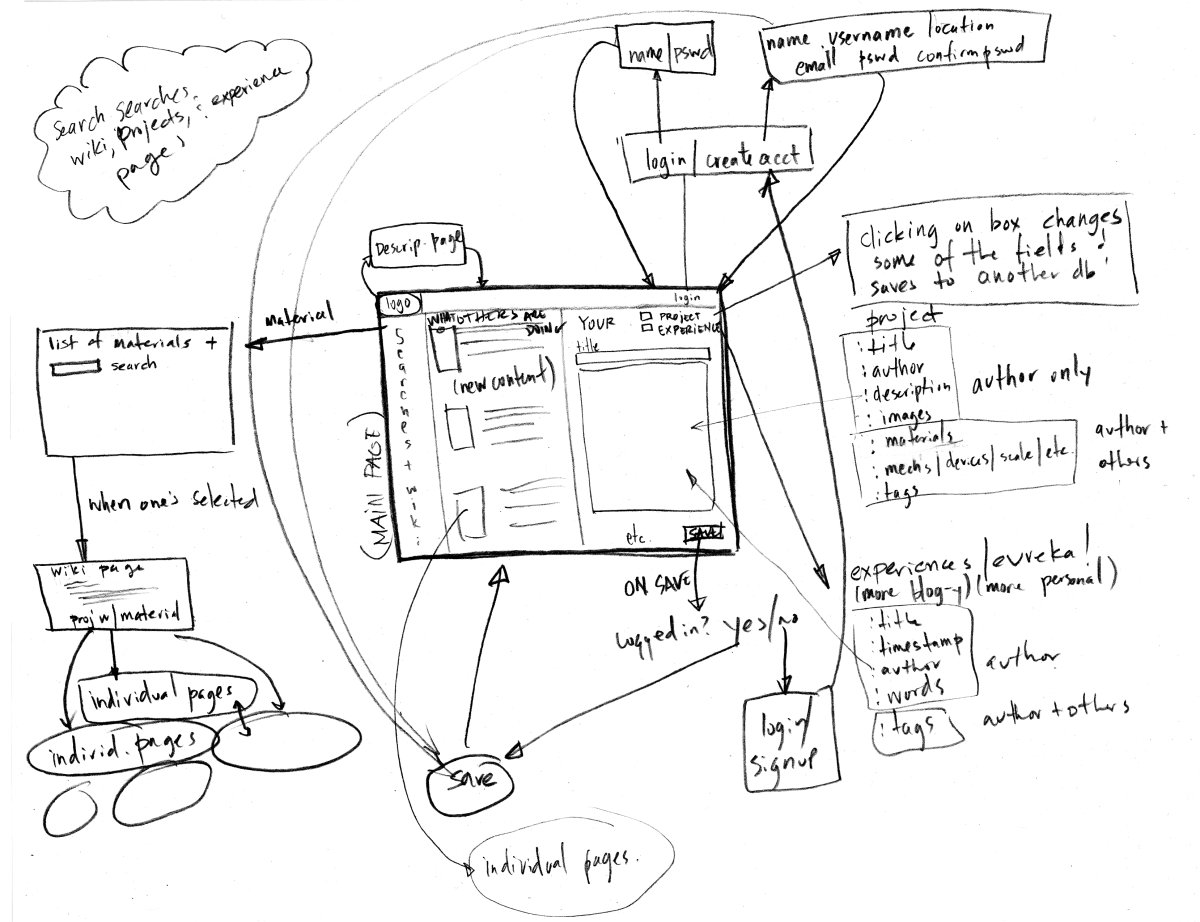
so, basically, from this, I will try to have three main types of content that can be added.
1) basic wiki. general knowledge. editable by anyone
2) projects (like pearls of wisdom, or instructables). people talk about what they made and how they made it
3) experiences (more like a blog... personal). people talk about their own experiences in the more personal. eureka moments. etc.
on imp so far:
implemented
*basic wiki add/edit pages
*basic projects add project
*add user
*basic login
*password authentication
to do in the next few days:
*save/edit projects with user
*save/edit wikis with user
*link login to main page
and the days after that:
*add/save/edit experiences with user
*tagging on all pages
*searching via tags
*image embedding
*video embedding
*sort out the main view
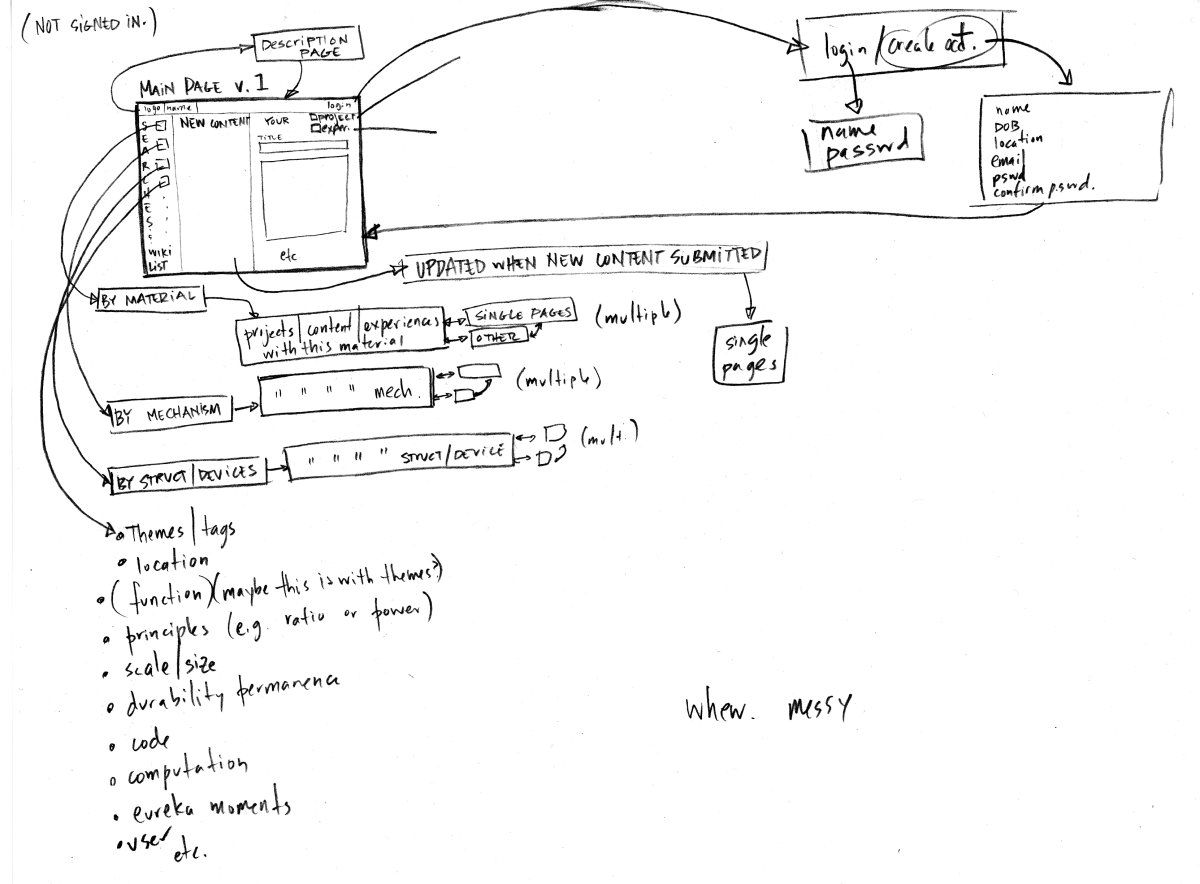
thinking about page flow
so far up and running on rails:
wiki - add pages/edit pages
projects - add projects
to do: a whole bunch more.
http://imp.dirtbetweenmytoes.com/wiki
it doesn't seem like much
but it's a first step, i guess.
(and in the meantime, another more real wiki
http://scripts.mit.edu/~nicholsl/imp/index.php?title=Main_Page )
When I was a young kid, LEGOs were a big part of my life. I used to love sitting around, building random cars and buildings. Unfortunately, there were only so many LEGOs my parents could afford, much less my own LEGO robotics set. Since I didn't have a good organization system, either, I used to spend the majority of my construction time looking for little parts that I was sure had to be there, but that I often couldn't find. But my desire to build never stopped at LEGO. Throughout my childhood, I never lost my fascination for building with wood blocks, scraps of wood, nails, rocks, hay twine, bits of wire, etc. Basically, I would build with whatever I had around.
Originally for my thesis, I had considered making a low-cost and appropriable construction kit, but for some reason, that never set quite right with me, never inspired me to work for it. After running two sets of workshops in Scotland centered around constructing with wire and other local materials, I realized that it wasn't the materials and parts I wanted to supply, but the ideas and knowledge with which to work with whatever materials were locally available. From this realization, I came to the idea of creating a sort of wiki/blog hybrid, a way to have both the sort of project-based how to combined with a construction encyclopedia. Here are some of the thoughts that went along with this change of idea.
First, I've always been frustrated with what I've been able to find on the internet construction-wise. Either there is a sort of how to, or there is the encyclopedia/textbook. If you end up working with the how to community, it can be rewarding, especially if you're the type of person who already has a good grasp on how to make things. For the beginner, though, this can be intimidating, and one sometimes has trouble knowing where to start. If you end up going to a construction encyclopedia/textbook, it can also be rewarding, but if you lack the assumed vocabulary of talking about these topics (fatigue, creep, moments, force, leverage, torque, power, etc), sometimes it's hard to grasp how the general ideas can be applied to projects. I propose that there should be some sort of way to traverse between these two worlds, between the specific and the general knowledge. The most logical and obvious way I can think of doing this is to have some sort of community/database of projects centered around making things which links back to a database/wiki/encyclopedia which talks about the general ideas (and vice versa). In doing so, you could, for example, read about a mechanism type and then see how it's used in various materials/machines. Or maybe if you had a large quantity of, say, cardboard, you could see how other people have used cardboard in their projects. By providing different ways of searching through projects and information, the user can build up an intuition about how things can be used and get ideas of how new concepts can be used in their own projects. Tentatively, I'm calling this the Idea Melting Pot, or IMP for short. My hope is that this website will function as just that, as a place where people can put their ideas and get ideas from other people, as a place where ideas can combine and meld and lead to new ideas.
Second, although I played with LEGOs, model rocket kits, Erector sets, etc., as a kid, the older I got, the more frustrated I was with these kits. The kits would come precisely with what you needed to make what the instructions said and you could make that, but it never was quite yours, you know? Say, for example, you bought a LEGO kit, no matter how large, you'd construct it with their instructions, and it would be beautiful, and you'd be so proud that you could follow instructions and make such a nice thing. Then you'd take it apart and try to make something of your own from the parts, and it would suck. You'd be disappointed and think that your ideas were no good. And then you'd give up for a while until you got a new kit. At least, that happened to me all the time as a kid, and is one of the reasons I didn't think I could build things well most of my life. From a learning perspective, ease of construction does not always equal greater learning or even greater accessibility. It seems that so much time and energy is spent on making kits that are easy and intuitive to use, easy to assemble, easy to buy and consume, with easy to follow instructions for an easy to grasp experience. It's not in the ease where you learn, it's in the struggle. When kits constantly provide you with good builds following their instructions, you learn that your ideas are not as “good” as their ideas. When the TV constantly shows “talented” people who are instantly good at things without having to work hard, you learn that failures are bad and that if you fail you aren't “talented.” When school constantly emphasises good grades, you learn that there's always a “right” and “wrong” and that you should be embarrassed when you're wrong. And I think this is completely ridiculous. You learn when you fail. “Failure” should be encouraged. Experimentation should be rewarded. We should learn the value of starting sloppily.
Third, again from a learning standpoint, by having the parts supplied for you in these kits, you never have to think of how to design the parts yourself. When kits are designed with connections and spacings in mind, users of these kits never learn how to reason their way through the design process from material to part. By not going through the thought process from material to part, builders miss out particularly on concepts in geometry, in joining, and in material choice. More generally, users don't always grasp how concepts can be transferred from one material to another. In addition to addressing new content, the ability to design your own parts also allows for the inclusion of aesthetic considerations into the part designs and the design of the whole.
Fourth, the older I become the more anti-consumer culture I become. Why do we need these construction kits, anyway, when there is tons of usable material being thrown away each day? Why not, instead, provide people with a way/resource to use the materials they have available, to encourage people to do so? In addition to easing the barrier to exploring concepts that were previously thought incapable of being explored (either by something being unavailable or too costly), this potentially provides for the knowledge of local uses of various materials to spread to places where these materials are also found. I think that we should enable and encourage creative re-use instead of encouraging the purchase and consumption of pre-designed construction kits.
Anyway. Just a few of my thoughts.
1 Introduction
The basis of constructionist learning is that one externalizes one's ideas through some type of construction material. During the construction process one needs to learn, appropriate, and functionally apply certain ideas in order to realize what one conceives. The properties of the materials are not only crucial to what one does and does not learn, as they facilitate or obscure the ideas inherent in the construction, idealization, and thought process, but also crucial in determining which populations are allowed access to the educational content inherent in the process of constructing with the given materials. In this thesis, I will propose and examine an open set of construction materials that incorporates wire and other locally available materials in an effort to bring to the forefront the need for accessibility in understanding key concepts in structural and mechanical engineering in communities that have historically been under-represented in these fields; I will explore the theme of interactive, artistic, mechanical creations as a way for builders to express and incorporate their own interests and stories into their designs, and thus, find a personal access point to concepts in mechanical and structural design; and I will explore the range of possible artifacts and styles of expression afforded by these methods and materials, and in doing so, will explore the range of potential new educational content such a process could provide.
Pre-fabricated construction kits, such as LEGO, K'nex, Meccano, Erector, etc., have been around for many years and can be a great way to introduce people to constructing and robotics; the kits' materials enable rapid and solid construction, as the parts and their connections are designed for this purpose. However, the cost of these kits, especially the robotics kits, can be prohibitively expensive. As a result, only certain people, communities, and schools are able to access the kits, and thus the concepts enabled by using the kits. This is particularly true for poorly-funded and poorly-supported schools, such as those potentially found in developing countries, rural areas, and inner-cities. Instead of relying on pre-fabricated kits, I will focus on using wire, a material which can be found almost everywhere in the world, as the basis for mechanisms; other locally available materials, such as cardboard, as the basis for structures; and the GoGo Board, an open-source/open-hardware Logo-based board, as the basis for computation. By exploring the use of these materials I hope to show that deep concepts in mechanical and structural engineering can be understood through using simple materials and tools that are available and accessible to a larger population than the population currently reached by pre-fabricated construction kits.
In addition to allowing greater accessibility, the use of wire as the basis for mechanisms allows for the incorporation of locally specific materials as well as the local knowledge about these materials and their roles in the community. The use of locally specific materials enables a community to access new educational content and to appropriate this new content for their own local needs. This same ability to incorporate local materials also allows the builders to add their own aesthetic touches into the design. This is different from pre-fabricated construction kits where aesthetics outside of the ones afforded by the kits become simple adornment on top of an assemblage of parts. This ability to have aesthetics integrated into the design allows for a different type of construction to be explored, a construction where the aesthetics and the design are united into one whole. Combined with computation and sensing through the GoGo Board, it is possible to have, for example, a set of constructions centered around interactive 3-D story telling/animation. By having a kit focused around such interactive, artistic, mechanical creations, it becomes possible for the builders to express and incorporate their own interests and stories into their designs, and through this, mechanical and structural design becomes more personally accessible to learners who might otherwise have no point of interest.
Many people have achieved successful learning about systems, feedback, control, and some mechanics through working with pre-fabricated construction kits, yet because these kits' connections and shapes are pre-designed by the manufacturer, several key concepts in mechanical and structural design are left unexplored when using these pre-fabricated kits. Because the pre-fabricated parts are designed with connections and spacings in mind, the builder has to provide very little thought as to how to space and connect. Thus, using a pre-fabricated kit means quicker and more intuitive construction, but also means that the users of these kits never learn how to reason their way through the design process from material to part. By not going through the thought process from material to part, builders miss out particularly on concepts in geometry, in joining, and in material choice. In addition to providing an access point for new hands-on educational content, the ability to design your own parts also allows for the inclusion of aesthetic considerations into the part designs and the design of the whole.
In addition to providing the design for the parts, the makers of these kits often provide step-by-step instruction guides on how to connect the given parts into the intended whole. Combined with the pre-designed and pre-fabricated parts this affords almost effortless construction. Although many people often de-construct the final whole to use the parts in their own constructions, the fact that the beginning user can usually never make something that is as well-designed as what is first built can lead to dissatisfaction which results in a possible lack of motivation for future constructions and therefore for future learning. However, typical to design, the affordances that ease certain aspects constrain others, and such is the case with having construction start with the materials rather than the parts. The time it takes to construct something solidly starting with only the materials and tools is significantly longer than with a kit that comes with pre-designed parts and instructions on how to use them. As experience working with the materials and tools, as well as experience with thinking through the whole design process from start to finished machine increases, the time it takes to construct a sturdy, aesthetically pleasing, and functioning machine decreases. In an attempt to address the potential rough start of working with materials instead of pre-fabricated parts and in an attempt to break from the tradition of providing a step-by-step instruction booklet, I will attempt to provide a learning framework for gaining experience about constructing one's own designs with accessible materials and tools through the use of a hand-drawn booklet focusing on the “grammar” of mechanisms and structures, the design process, and possible ideas on how to find or scavenge local materials. Additionally, because mechanisms are notoriously hard to explain with static representations, I will provide a collection of animations that represent the funcions of the different mechanisms. All of this will be openly available via the Internet. It is my hope that through this work, I will enable the learning of mechanical and structural engineering concepts to as wide population as possible.
so i figured i'd talk about mechanisms and the ways i've noticed the kids approaching them.
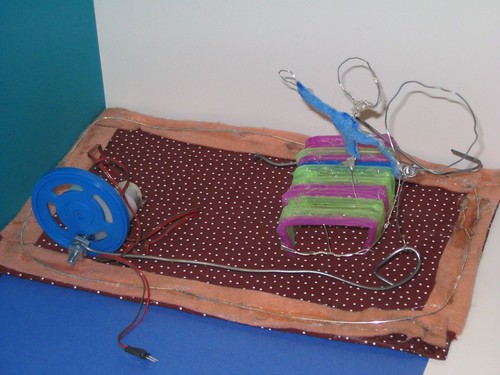
it seems that the kids find it easiest to grasp simple rotational motion off the bat. the fact that they can plug the motor into the gogo board and instantly see it run aids in this; it's obvious what it does. many groups have made merry-go-rounds, roundabouts, etc. from there, many groups have gotten the idea of increasing the diameter of rotation to make it look like it's going "faster"... making car chases, etc. i haven't counted all the projects, but it seems like even if this isn't the idea that ends up being used in the end, it's one of the first ideas to be had.
from there, one increase in complexity comes when using the motor as a wheel... a simple sort of rotational to linear motion, and something that is available for observation in their everyday lives.
these mechanisms (rotational and wheel) come about from a direct observation of the affordances of the motor. and maybe if the group is starting without a clear idea of precisely the motion they want, they're more likely to allow the materials to dictate their design more throughly.
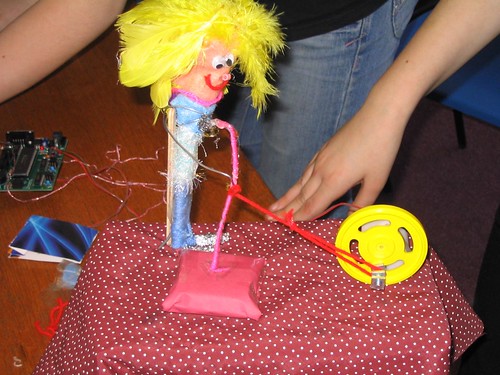
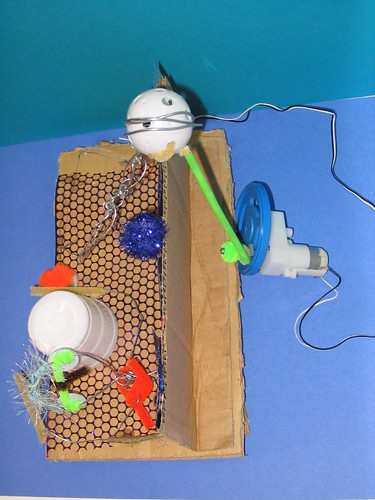
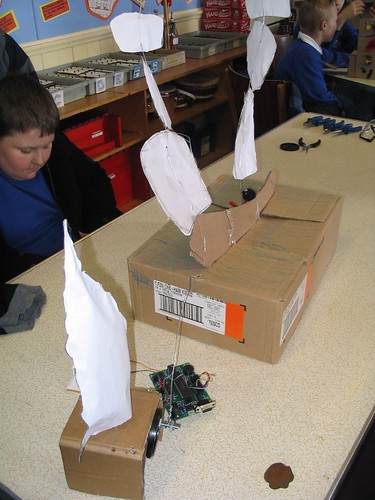
more complexity comes when the kids decide to use the motor with a string as a simple winch. this is something i had not thought of, but it makes sense as a concept that is available in western society with the idea of a reel (rod and reel). this first came about with the pultneytown p7 group in wick, and after that, as their photos got introduced into the photos i showed in the beginnings, more and more groups did this.
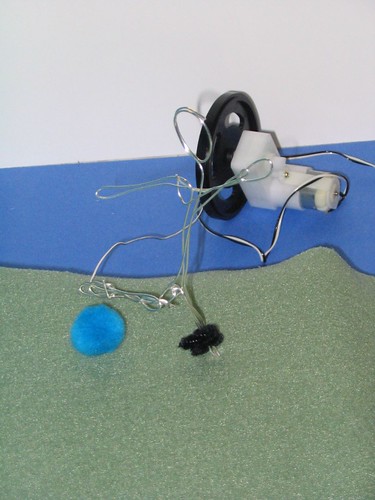
another sort of motion that kids ask for, but don't know quite how to get, is some sort of jumping motion or rocking back and forth. i try to ask them if they have seen anything like this, but a lot of kids haven't. a couple of kids came up with a crank/single link system; they were all mechanics' kids, i found out upon questioning. usually i have to suggest this idea by suggesting that they look at some of the photos/videos of what other kids have done in hopes that they will find something useful to them. i also try to have at least one physical example of a single link system. a common mistake kids make is that they try to hold the link still at the pivot on the wheel. they then seem surprised that it doesn't work. when this happens, i never tell them they've done it wrong, but rather, i ask them questions about why they think it doesn't work. usually after one or two questions about what they think would happen if the pivot isn't a pivot, they figure out that it should move.
a couple of teams are able to use/understand two linkages, but only when the mechanism is presented to them as something to play with and build off of.
jose valente suggested that i try to be clear and aware of my effect on the kids. my effect becomes clear when i question and steer them towards certain mechanisms... or even just suggesting that they go look at other groups. my effect is also clear with the two bar mechanisms. i don't think any of the kids would've come up with that on their own in the time they had (neither the two hour workshops nor the two day ones). just from my own experience, i don't know that i would've come up with it if i hadn't have seen an example. so i think that the role of examples, providing examples, and providing a suggestion as to where to look is important.
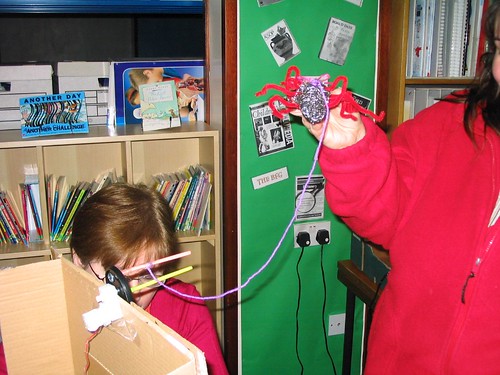
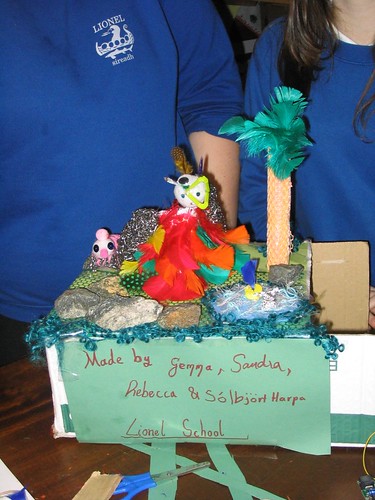
i also think that it's important to look at the way these groups approached their projects. some grabbed a material and were like... this is cat's fur! we will make a cat! and others were like... this is the motor, we can make a wheel, we'll make a car. even others were like... we want to make this, how can we make it move like we want. so, either an idea sparked from the materials (be it the motor or the craft materials or whatever) or a goal formed from their own imaginations and finding the materials and methods to fit that. those seem to be the two ways that the groups approach things. and with those two approaches, there are different results with different mechanisms. it seems to me that the groups that have their own motion in mind are more likely to push what they can do with the motors/programming, whereas the ones who get their mechanism idea from the observable affordances of the motor/wheel seem to make machines that either drive around or spin.
another mechanism animation from sadie and me.
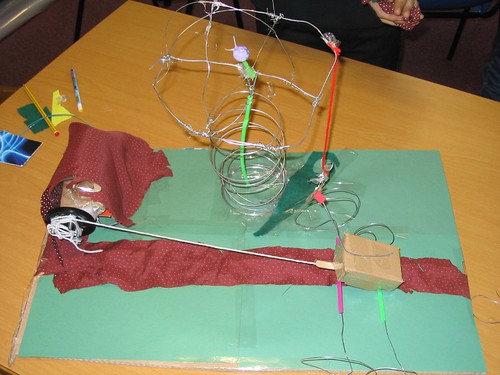
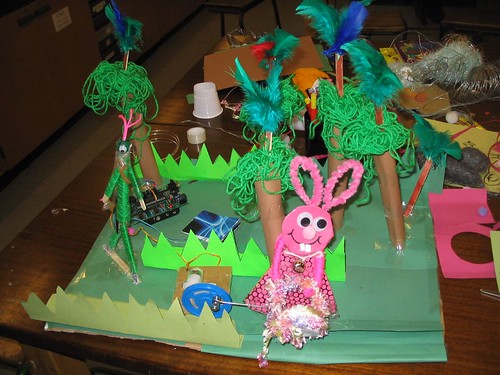
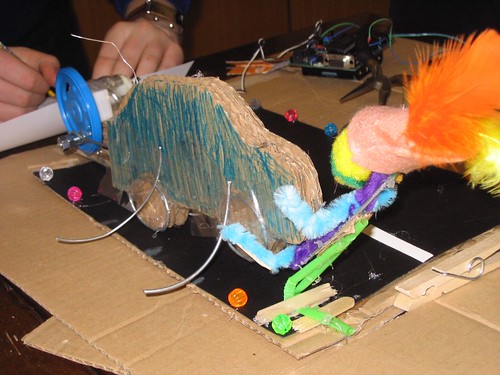
and here are some of the things that the kids in scotland built using this mechanism
this is the first group that thought of doing this. after them, there were more.
tank
a group of teachers make charlotte's web
hickory dickory dock (teachers)
raising a flag
little red riding hood
skier going up a hill
an animation Sadie Scheffer and I made of a crank with a single bar.
These are some models made by young people in Scotland which use this mechanism:
singing girl
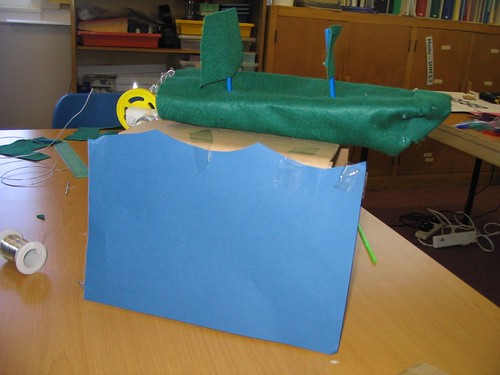
boat
sunset
easter bunny
car crash
drummer
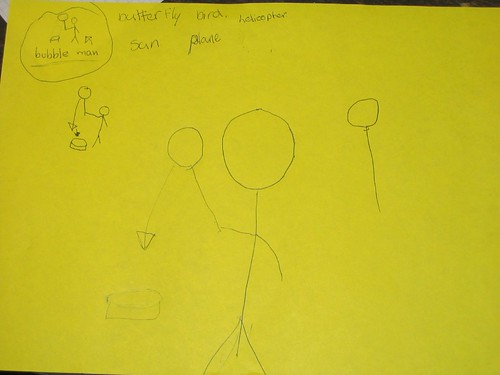
man blowing bubbles (plan)
man blowing bubbles
man kicking soccer ball
flapping bird
ship crashing into iceberg
girl jumping on trampaulin (close-up)
on the reactions of girls to the workshops:
The first 2-day workshop went wonderfully. Afterwards, the kids all wrote personal little essays about their thoughts. Two of the girls (out of the 30 total kids) specifically said that they loved the workshops and had never thought science could be so fun. I was especially excited at this, because the girls who said this had shown real understanding about mechanisms and the building. In fact, one of these two is one I'd say understood things best out of the whole class, both this workshop and the shorter three hour one I did with this same bunch back in February. She seemed really keen to design and build things, coming up with the idea of making a track and having a pulley through a straw to pull Jack up the hill.
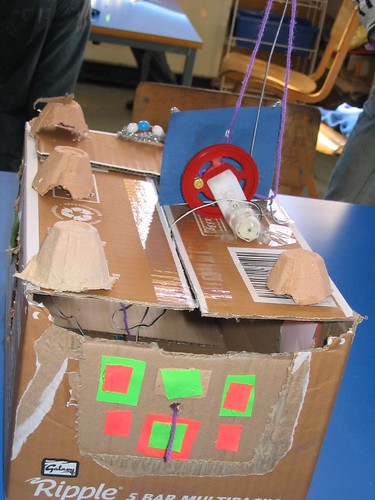
More generally, the girls in all the workshops seemed to be involved and engaged and on talking to them, most seemed to have a reasonably good idea of what they were doing and what the group was doing. In all-girl groups, it was good to see that the girls had to make things. In mixed groups, sometimes it ended up that the girls did the crafty part and the boys did the mechanisms, but that wasn't always the case. Particularly, in one group, the boys were the ones doing all the crafty bits and the girls were working on the structure and the mechanism to make a disco ball drop down from the sky. Another mixed group was more united, with everyone doing bits here and there. Some doing structure and would then start decorating the structure. This group (made a jewelry box) had a very mixed distribution of tasks. The group with the flying car also had a nice way of dividing up things evenly. There was one girl in one of the classes who was great. At the final class discussion, she really asked a lot of questions and was happy to talk about things. Definitely no shyness there.
Many of the teachers and helpers who came along commented that quite often the groups with girls and the all-girl groups tended to make a better thing overall. More care was paid to the making of it, and getting it to look how they wanted. I had thought this myself, so it was good to hear this from some source other than myself.
On having autistic/special needs kids in workshops:
These were the first workshops I had any sort of special needs kids, which was quite the experience for me. Mostly so, because I was amazed at how compassionate and accomodating the other kids were. But also because I was pleasantly surprised at how they got on in the workshops.
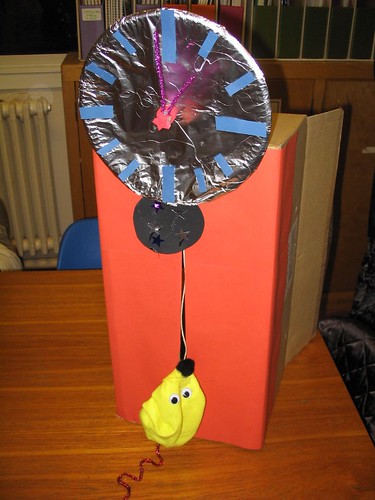
There was one kid who was autistic who insisted that everything be yellow and that it had to have a clock. He was working in a group with four other kids. They all wanted to make a car. So they talked with him, and he was insisting clock, so they came up with making a car driving around a yellow clock. They started making the car, yellow car for the boy, and he set off making a yellow clock. He made the structure to hold it and they all worked together to get it all together. In the end, it was a yellow car flying around Big Ben. During the two hours I had with them, they were all engaged and happily working.
At another workshop, there was this kid who had a hard time doing anything. One of the helpers I had was really good with him, though, and would sit and talk to him about what he was doing. The kid set about making a scoop to pick things up (like... the motor spins around and has a scoop to grab things at the bottom). He stayed busy the entire time, though I don't know that he was really able to do much. His teammates were very nice and tried to give him things that they thought he could do, and included him on everything on the project.
Another girl, the last day, was this special needs kid who also had hearing aids. And apparently when she got bored or didn't want to do something, she would switch her hearing aids off and then they'd take her back to the special ed part of the school. She had done just that earlier that day at a K'nex workshop, so I was worried about how she would take mine. But she stayed until the very end, working away on making a basket full of easter eggs and helping make this chicken popping out of an egg. She seemed really happy to work on what she wanted, and her group was happy to have her do that.
And the last kid, somewhat autistic. A little slow seeming when you talked to him. He was the guy who helped everything but who didn't really come up with anything on his own. But he was really useful for the group getting their thing done (a penguin with a fish in its mouth with flapping arms and chewing mouth). When one of the visiting teachers asked what he had been working on, he said "nothing," but the rest of the team started saying "no no no... you did this and this and this and you helped with this. you were kinda the manager." Which I thought was really sweet.
Anyway. It was interesting for me to see how they worked and how they worked in the groups. And it was good to see that, for the most part, they all found something to do to help the overall progress of the projects.
Thoughts on Geertz's Local Knowledge: "Art as a Cultural System"
If art is, as Geertz says, something that must be viewed within a cultural framework, if "to study an art form is to explore a sensibility," if art "materialize[s] a way of experiencing, [and] bring[s] a particular cast of mind out into the world of objects, where men can look at it," (Geertz, p. 99), then art, as such, goes hand in hand with engineering, with science, at least if one is to follow a more critical theory of technology. As Feenberg says in The Critical Theory of Technology, "[m]odern technology is no more neutral than medieval cathedrals or The Great Wall of China; it embodies the values of a particular industrial civilization and especially of its elites, which rest their claims to hegemony on technical mastery." Engineering... conceiving of and making an object... is a way to bring an internal experience, an internal knowledge, "out into the world of objects." David Nye in Technology Matters discusses the history of technology and story, saying the two are inextricably intertwined to the point where it's impossible to know which came first. Story is intrinsic to technology, and also to art. If we had no reason to make something, we would not make it. Whether that reason is "expression" or "to do such and such" is immaterial. A rudimentary story is the drive, at least to the point of "I will use this material and that material and possibly this other one, go through this process, and come out with something that (hopefully) resembles my conception." These stories are influenced by the values of culture that one comes from (to influence what seems "worthwhile"), by the perceived affordances of the materials, by the personal experiences of the maker, etc. and, as such, engineering, technology, and art are should be viewed within and understood through the cultural framework of the maker.
And, really, if you look at it as such, art and engineering aren't so different, after all. One just pretends to be objective (to the point where some people believe technology to be deterministic), where the other admits its subjectivity outright. But both are the using of materials to make a final thing... only the story, the process, are different.